FOREWORD
King Arthur and his Knights of the Round Table, the stories of Merlin and Sir Lancelot are all part of the ancient memories of a people who barely emerge from the clouds of time. The first written document about the Round Table came from the works of Wace of Jersey, entitled
Roman de Brut, dated 1155 A.D
[1] The legend’s origin reaches back into a distant past we arrogantly call pre-history, even though it contains the greater and most decisive part of our human history. Although the legends of King Arthur come from a magical age their message is still relevant to us — all too rational residents of this century — as myth and history unfold in all our lives, just as much as it did at the time of Arthur. The Arthurian legend is intertwined with the very fabric of British thought and became its Holy Grail, in which all quests and dreams, dictated by our higher nature, have come to rest through untold centuries. The traditions of the legend are very actively adhered to even today, as evidenced, for instance, by the caring of the ravens in the hope of Arthur’s return and with him the re-establishment of a new Golden Age.
As more knowledge becomes available through research, concerning the origins of the Arthurian legends, the mist of time begins to lift. People, places and events take on a more and more discernible shape. From this new knowledge, new questions arise and new answers have to be found. The new information brings some ancient people and their history into focus, who were previously not associated with the Arthurian legends. These newly discovered cultural strata not only help to explain the era of the historical Arthur but they also help to open up the ancient layers of history of the British Isles, through a new appreciation of the river and place names these ancient peoples left to posterity.
Some of the new research points us to some quite unexpected people as originators of the Arthurian legends. These are the Sarmatians and, the Alans, ancient peoples who once inhabited much of continental Europe and their descendants, the Ossets, who still flourish within the boundaries of what used to be the Soviet Union, in the Caucasus region. In the 1997 January and February issues of the
Archeological Journal, Scott C. Littleton, Professor of Anthropology at the Occidental College in Los Angeles, published an article entitled
Were Sarmatians the Source of Arthurian Legend? He writes that, in 175 A.D., Marcus Aurelius dispatched 5,500 Iazyg (Sarmatian) warriors from the Danube region to England. In Professor Littleton’s opinion, it is from their culture that the Arthurian legend and the legend of the Holy Grail originated.
Some well established Sarmatian communities flourished within the Carpathian region, confirmed by the many graves uncovered by archaeologists. Their distinct style can be followed from here all the way to Western Europe and even the British Isles. Here they left their mark not only in memorial stones but they also established horse breeding and cavalry. They influenced fashion and, more importantly, they have left us their belief system and a code of honor through their legends. They also left behind a memory of a Golden Age and an unshakable belief in its return.
When investigating the Sarmatian-Iazyg presence, one inevitably finds oneself connected with an increasing wealth of data concerning the Arthurian legends. Embedded in these legends, there are clearly defined Magyar linguistic and mythological connections. The legend of the Holy Grail and the legends of the holy cups of the Magyar people lead us ultimately to the Hungarian Holy Crown. The legends of both the Holy Grail and the Hungarian Holy Crown are interlaced with the same high spiritual contents and aspirations. The recognition of these facts encouraged me to further my research into this subject. Following this line of investigation, many additional data surfaced and were added to the already existing vast material that supports the ancient European presence and Sarmatian connections of the Magyars. Evidence will be presented demonstrating that the Sarmatians were a branch of the Magyar-speaking peoples of the time. There is one Sarmatian grave in Hungary of utmost importance, which contained not only phalerae, but also writing executed in Magyar runic script (rovás) in the Magyar language. This is one proof that the Sarmatians were a branch of the Magyar-speaking peoples of the time.
The reader may justifiably ask the reason why such a paper as this one has to be authored by a person residing in the United States. Should not such quest rightly be expected to come from the scholarly circles in Hungary? The answer to this well justified question lies in the facts of the history of Hungary and, consequently, her historiography during the last one and a half centuries. These reasons probably remain incomprehensible to an American or British scholar. Since the presentation of a comprehensive explanation is beyond the scope of this Foreword, I am asking you to refer to the works of the late Hungarian historian, Professor Tibor E. Baráth who in his book
[2] presented a good account of the problem.
Due to the determined efforts of the responsible branches of the Hungarian Academy of Sciences (Magyar Tudományos Akadémia, abbreviation MTA)
[3] — and the ingrained habits acquired during centuries of Habsburg and later Soviet domination — Magyar history, heritage and language has remained and still remains hidden from the world. Consequently, this culture-vacuum has caused many confusing misunderstandings, in the interpretation of ancient European history, even for the most dedicated and objective of scholars. Researchers are often forced to look to the Far East for explanations of customs and belief systems, when trying to find the origin and meaning of the ancient European cultures and legends. This was the case, for example, concerning the history of the Druids: western researchers looked with little enthusiasm to the East for Druidic origins and customs, even though the explanation is clearer and lies closer at hand, within the Magyar culture of the Carpathian Basin. The Hungarian historian, István Bóna,
[4] argues that, until only recently, western scholarship has neglected to paint an accurate picture of the Huns. Even now Academia still holds onto old, ingrained prejudices concerning their society and history, rather than basing their knowledge upon research gathered over the past hundred years. They fail to recognize that these distorted historical pictures were painted by the former enemies of the Huns and, even though this disinformation was never supported by any archaeological or historical data, or was absolutely contradicted by primary sources contemporary to the events, scholarship still clings to them. Renata Rolle came to similar conclusions concerning the history of the Scythians. Such misinterpretations are even more evident concerning the history of the ancient and indigenous Magyar peoples in their ancestral homeland in the Carpathian Basin. Archeological finds and genetic research lead us to the dawn of history and reveal a homogenous culture in the Carpathian basin, which leads without interruption to the present.
The farther we go back in time to the ancient layers of history, the closer we get geographically to the Carpathian Basin and the culture-sphere of the Magyars. The data that have emerged from the excavations have shown that the people mentioned in the earlier days under a variety of names, such as Huns, Alans, Sarmatians, Iazygs, Pannonians and Ionians, were kindred branches of the Magyar mother culture just as are the Jász, the Palóc, the Székely, the Matyó, the Sárköz and the Csángó people of today, to mention only a few. These names are part of a pre-nation antiquity as parts of the Magyar ethnicity.
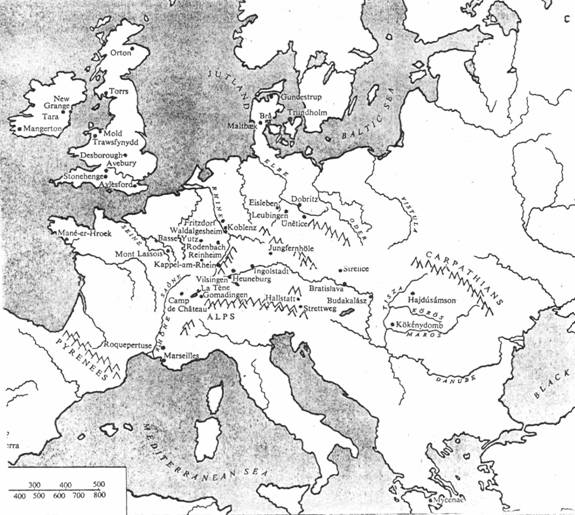 Figure 1. Map of ancient Europe
The present work gives a foretaste of the immense material open to researchers of Magyar history and which, until now, is only a tabula rasa in the consciousness of western scholars. I am following the outlines given by Professor Littleton concerning the Sarmatian-Iazyg line and the insights given by Professor Geoffrey Ashe into the mythological material of this and previous eras, with special emphasis on the surfacing linguistic and cultural data.
Although strong efforts have been made to separate the cultural links between the British Isles and the Carpathian Basin, under the appropriate headings, such separation at times becomes artificial and I was compelled to allow for a reasonable overlap.
With respect to historical names, it has been decided, after considerable pondering, to use the original names of historical figures, writers, etc. not only out of deference to them but also because they sometimes helped to advance the subject matter. The common English usage follows the original name in brackets i.e. Plinius (Pliny), Ptolemaios (Ptolemy), etc. In this class of explanations belongs the Hun King’s name, which I spell Atilla, according to Magyar heritage. The name spelled with the double “tt” corresponds to the Indo-Germanic mode of speech and lacks meaning and a historical background.
I also have to clarify the frequently mentioned reciprocity of words. In the most ancient layer of monosyllabic words we find that several possibilities of expression are open through the use of reciprocity, the trading of positions of consonants. This may also hold true in the case of the first syllable of a multi-syllabic word. This process:
1. may change the mood, quality or substance of the word
2. may express the connection and interchangeability of the masculine/feminine aspects of creation as in “kupa” and “bak” (cup and buck) and, through this, the interchangeability of energy and matter, since the free flow of energy was considered a masculine characteristic and the properties of matter – such as memory, a stationary state, the capacity to enfold and contain – a feminine concept.
Such reciprocities are present in the English language also, as in the case of tub – bat, the former being a feminine, the latter a masculine concept. A change in quality: tap – pat, a change in substance or quality: God – dog.
It is more impressive that this reciprocity exists between more than eighty Magyar and English words.[5]
I also have to employ several linguistic possibilities when explaining some phenomena in the names or other significant features of the Arthurian legends, which have not been codified in Indo-Germanic linguistics. Among them the rôle and meaning of individual sounds, both vowels and consonants, such as the feminine – masculine concept as expressed in the T-R word-group, through the use of vowels: the high vowels (Magyar “Á” and “É”) represent feminine concepts, like
tár (to open),
tér (enclosed place). The deep sounds (Magyar “Ú”) stand for masculine concepts like
túr (to dig).
The role of the ancient monosyllabic words which pertain to nature and their connection with objects of civilization or technology has to be emphasized, when looking for the origin of words: one must turn to the words of nature as a point of origin.
For these and several other unique features of the Magyar language please turn to this author’s
Szerves magyar nyelvtudomány[6] (Organic Magyar Linguistics) and Adorján Magyar’s
Az Ősműveltség (The Ancient Culture).
CORRESPONDENCE WITH PROFESSOR GEOFFREY ASHE
Geoffrey Ashe
Chalice Orchard
Well House Lane
Glastonbury
Somerset BA6 8 BJ
8th May 1998
Dear Mrs. Tomory,
Many thanks for sending me your booklet, which arrived while I was away in America. Your interest in my own work is much appreciated. I have far too little knowledge of etymology to be able to comment usefully. However, I have believed for a long time that elements from seldom-recognized sources may have found their way into the Arthurian Legend.
Yours sincerely
Geoffrey Ashe
Excerpt from the comments of Professor Paul Maier
Professor of History at Western Michigan University“This is a remarkable — and scholarly — study of Magyar cultural influences on Western Europe that — in the thesis of this author — were earlier and more extensive than had hitherto been imagined, affecting even Arthurian legends in England.”
ACKNOWLEDGEMENTS
I am grateful to Professor Meier, Professor of History at Western Michigan University who was kind enough to read the draft manuscript and provided me with many useful suggestions. His comments led me to include additional material in the Appendices that will help interested readers to better connect with the subject matter.
I would like to thank Prof. Geoffrey Ashe for leaving the door open to the possibility of hitherto unrecognized elements having a part in the development of the Arthurian legends.
Mr. Dan Robinson, Keeper of Archaeology at the Grosvenor Museum in Chester, England, provided important data concerning the period of the Sarmatians’ sojourn in England, and kindly answered several of my later questions for which I am truly grateful.
I would also like to thank Mr. László Török for his time, energy, and advice in bringing this work to completion.
Mrs. Margaret Botos unselfishly gave her time and energy to edit the final draft for which I am truly grateful.
Last but not least, I also thank my son Mark for helping to win my many battles with computer and related technologies.
SARMATIAN-IAZYG CONNECTIONS
I.
Sarmatian presence in the British Isles
When following the traces of the Sarmatians in the British Isles, one has to come to terms with their historical presence in Britain, and their name. Mr. Dan Robinson, Keeper of Archaeology at the Grosvenor Museum in Chester, England, provided important data concerning this period. Historical sources tell us about their presence under this name in the time of Marcus Aurelius. 5500 Sarmatians were settled in Britain who seemed to have disappeared, except for one “ala” (cavalry regiment) of 500 men in Ribchester. Chester, 60 miles south of Ribchester, acted as the administrative center for North Wales and West England and forts like Ribchester were subordinated to the Legionary base at Chester. One solitary Sarmatian grave remains in Chester.
[7]Sarmatian monuments in England [8]
The following memorial stones, concerning the Sarmatians in England, deserve special attention.
A silver statuette of Victory was found in 1793 at
Tunshill farm, Milnrow, Lancaster, in England, two miles east of Rochdale, near Hever castle. The statuette is embellished with a silver plate attached by a chain to the statue’s right arm. The statue was a donation to commemorate the victory of the
Sixth Legion, which was the Sarmatian legion at the time. This memorial text was copied in 1930 and can be found at the Tolson Memorial Museum in Huddersfield, England. The letters of the silver platelet have been punch-marked, which is characteristic of the Hungarian decorative art.
The shaft of a rectangular pedestal was found in 1578 at
Ribchester, then taken to Salesbury Hall, where the inscribed face was built against a wall. It was rediscovered in 1814 by Whitaker, who bequeathed it to St. John’s College, Cambridge, where it still remains. The top of the shaft has been roughly dressed with a chisel and has drafted margins and an oblong lewishole to take a superimposed stone. It is part of a monument, not an altar. The left side, from which the surface had broken away before 1578, was subsequently trimmed with a chisel. On the right side is a relief of Apollo, nude except for a cloak draped from his shoulders and a headdress, which seems to be a
Phrygian cap. He has a quiver on his back but there is now no trace of his bow, which may have stood at his left side. He rests on his
lyre, which stands at his right side on some small object.
The back has lost about 4 inches of its right margin but no part of the sculpture. On it stand two female figures facing one another, each in a niche. The left-hand figure is
young, has flowing locks, and wears what may be a turreted crown, but
no veil. Her drapery covers her back and shoulders,
but leaves the entire front of the body bare from the thighs upwards. The right-hand figure wears a similar headdress, but is
veiled and fully draped. She is handing a box-like object to her younger companion. They are believed to be the personifications of the
Regio Bremetennacensis and
Britannia Inferior, respectively. It was preserved in a drawing by *R.G.C. in 1927, with additions by R.P.W. in 1943*. The inscriptions reveal again the presence of the Sarmatians within the sixth legion, at the time of Gordian (A.D. 238-44). Here the Sarmatians give thanks
“To the holy God Apollo Maponus ...” Further descriptions of memorials and contents are part of the Appendix. On these we find the name, in Latin
Mars the Peacebringer.[9]The Roman legions:Vardulli, Vascones, Frisii, Sarmatians, Barcae" of that time employed the help of varied nationalities, in order to achieve their goals. Among them are the Vardulli and the Vascones of Spain, the Frisii from Holland, the Sarmatians from the Carpathians and the Barcae Tigrisensium, who were originally stationed at the river Tigris.
[10] This latter legion merits mention again in connection with the Carpathian lands, where we find a region called Barcaság, the land of the Barca.
Peter Salway
[11] mentions the Marcomanni and Quadi in the Danubian region next to the
Sarmatae-Iazyges, thus placing an equation mark between the two names. We have ample details of the Iazyges, who were one of the indigenous populations of Pannonia.
Salway also mentions the enormous influence the Sarmatians had upon the histories of England and Scotland. Cultural centers were also established by the Sarmatians, and laid the foundation of British horse-breeding. The Sarmatians achieved considerable social status and the commander of their cavalry unit acquired the title of
praepositus regionis, which was usually not given to foreigners.
Further Messages of the Sarmatian Monuments of England
We mentioned earlier the memorial stone on Tunshill farm and the Ribchester monument. We emphasized the decorative elements and attire found on these memorials.
On the memorial stone No. 137, in the Grosvenor Museum’s collection in Chester, we come face-to-face with the originators of these memorials,
the Sarmatian cavalry-man. Even though there is no writing on this stone, we can learn a lot about him. He wears a conical cap, tightly fitting riding costume, soft boots and a flowing cape. He has a straight, short sword, used by horsemen of that age. With his two hands he holds a banner, upon which the Sarmatian symbol, a dragon, rests. Through the accurate representation of the dragon-banner we also know that the body of this dragon was hollow and acted as a weather vane. The foot of the horse displays an elegant stride. The entire picture shows a very cultured person, who enjoys beauty in his clothing and surroundings. He was also a very proud representative of his people.
His pride may well have stemmed from the fact that -- even though his home base was next door to Rome -- his country was never occupied by Romans. They may have lost some battles to Rome, as in 173 AD, during the reign of Marcus Aurelius, but were never defeated as a nation. This fact may explain Peter Salway’s dilemma as to why the
“commander of the local unit” had the special title of
praepositus regionis. These Sarmatians were part of a non-occupied nation deserving respect.
We know from written sources that they formed the sixth legion and took part in Rome’s ventures in England and Western Europe. Professor Littleton mentions that the first commander of the Sarmatians was Lucius Artorius Castus. According to the inscription on a stele, he led his troops to Gaul in 184, to quench a rebellion. Like the legendary King Arthur, he too led a cavalry into the European arena. “The first Sarmatian leader of the Ribchester contingent probably took on the title
artorius, borrowing his commander’s name. A subsequent leader may have been King Arthur, the ’Artorius,
dux bellorum’ (war leader)...” writes professor Littleton. King Arthur saved Britain by defeating the Saxons at Badon Hill in 510 A.D. We discussed the further implications of this title in the Journal of Hungarian Studies issue 2, along with the Sarmatian Iazyg affiliations.
Professor Littleton discussed a relationship between the
Sarmatians, Scythians and the
Alans. According to his research, the entire legend of King Arthur and his court, the Round Table and the Holy Grail are of Sarmatian origin. He identifies Sir Lancelot with a leading personality of the Alans who arrived in the West in the fifth century. The legends of the Holy Grail later became embellished with Christian myths that never really found favor in the eyes of the Church.
Professor Littleton places the Alans and Scythians into the Indo-European language group and connects them with the Ossetians, where the major elements of the Arthurian legends are still alive. The science of Linguistics has just begun to replace the outdated methods that were established in the 19th century, and which relied heavily on the concept of “language families”. Newer methods look into the common vocabulary of the Eurasian languages and their obvious connection with one another. The Nostratic theory widens this circle in order to embrace the world. Presently the Magyar language is excluded from these efforts, although it is a key language toward fuller understanding. The Magyar (Hungarian) linguistic and cultural connections will be discussed in a later chapter. This practice is due to the results of the old Habsburg power politics, the “Drang nach Osten” push on Hungary’s western borders and the expansionist efforts toward the West, from Hungary’s neighbors on the eastern side. For these reasons these politics are still alive and well in today’s Hungary. The misrepresentation of Hungarian language and culture by the Hungarian Academy of Sciences had already begun during the life of its founder, Count István Széchenyi who protested against this trend and withdrew his support from this institution.
Presently, I am discussing the cultural traits of the Sarmatians in England and the possible connections with the Magyar culture sphere. I shall repeat the earlier discussion concerning the Sarmatian memorial stones, with some further clarification concerning these cultural connections.
In 1578 a statue of Apollo was found in Ribchester and taken to Salesbury Hall, where the inscribed face of the stone was built against the wall. It was rediscovered in 1814 by Whitaker, who bequeathed it to St. John’s College in Cambridge, where it remains. It honors a centurion of the sixth legion, which was the Sarmatian legion. It dates to the time of Gordian in 238-44 AD in Melitene. The inscription of the memorial was discussed in detail by R.G. Collingwood and R.P. Wright’s
Roman Inscriptions of Britain, (Vol.I. , Oxford 1965, part 583).
An Apollo-like figure is the central element of the memorial’s composition. I call it
Apollo-like because its representation is very unorthodox from a Roman point of view. He wears a “Phrygian” cap. He has a quiver but the bow is missing and may not have been there at all. Instead he holds a harp in his hands.
Next to this young man stand two female figures, an older and a younger one. As stated previously, their flowing garments did not cover their breasts. The younger lady also leaves her hair -- flowing, curly locks -- uncovered. These facts point toward a type of fashion, which was definitely not of Roman extract. They are believed to be “the personifications of the
Regio Bremennacensis and
Britannia Inferior respectively.” But why? We have no report of such pre-Roman fashion on the British Isles. Since Brementennacum at that time was the home base of the Sarmatian/Iazyg cavalry, we have to look into the possibility that, as the neatly clad “dragoneer” represents the Sarmatian military fashion of the day, the two females bring the female fashion of these people to light. This fashion evolved on foreign lands, very possibly in a much gentler climate. We have to look for analogies outside England. And the God who stands next to them? He is also very possibly a God the Sarmatians recognized as their own. This God’s Phrygian cap also points toward the southern part of Europe. The harp in his hand talks about a people whose tradition holds fast to the idea that all of creation is but the song of the Sun-god. The same people honored all the poets and bards as God’s representatives here on Earth. As we shall see, the myths of Taliesin and the bards are in direct connection with this line of ancient belief-system.
Adorján Magyar quotes Spamer,
[12] concerning the painting in a Roman catacomb, where Jesus is portrayed as Orpheus with a harp in his hands, as he sings to the animals. He wears a Phrygian outfit, which is usually not a part of Orpheus’ or Jesus’ wardrobe. We have to look for another culture’s divinity. Adorján Magyar followed the evolution of this type of attire. He also found, in Spamer’s collection,
[13] that Attis was portrayed in a Phrygian cap and tight trousers, made apparently from leather. The traces lead to the Pelasgians who -- according to Herodotos (Herodotus) -- spoke a barbarian language,
[14] before they converted to the Greek language. Attica was a Pelasgian territory and the city of Plakia was also of Pelasgian origin. The Pelasgian culture leads directly to the Aegean, pre-Greek cultures, one of which was the Ionian. Later, we shall see the Ionian-Iazyg connections with the Carpathian Basin. Later, we find the same trousers not only in Scythian representations but the Hun fashion too. This ancient and very useful garment still survives in the Carpathian region as part of the Hussars’ uniform of Hungary and it is still worn in Transylvania. The Albanians also preserved an attire remarkably similar to this in material and cut. This trousered fashion points to the Carpathian Basin, as the center where it was developed and from which it spread, first to the neighboring lands, later to distant countries as well. It was the traditional attire of ancient Magyar ethnic groups, who carried this fashion with them wherever they settled. Later the trousered fashion was adopted by most people -- with notable exception of the Romans and some of the inhabitants of India -- due to its comfortable nature and it is used as part of the European and American fashion to this day.
Based upon fashions alone, we have to look for the “Attis, Orpheus and Apollo-like gods” among these ancient trousered people, which included at one time the Sarmatians too. Furthermore we have to look for other identifying features also, especially the linguistic connections.
Let us examine the details of the two women’s attire. The ringlet hairstyle of both women greatly resembles representations from Crete, from where it also spread to Canaan and Ugarit
[15]. The bare-breasted fashion was common too in these regions. The emphasis on this flowing hairstyle was also part of the Trojan culture with significant linguistic ties to the longhaired Achaios, as was described by Homer.
Another unifying bond of these representations is the famous “Ionian” profile on all of these paintings, which is also a characteristic of the Jász ethnic group in Hungary. Adorján Magyar identifies the Iasi, Ion, Iassius, names of ancient history with the Jász.
“... We can observe that this relief is completely analogous with the Crete-Mycenaean art, not only the highly characteristic profile but also the several other details such as the hair, as it encircles the forehead in tiny ringlets, the long lock of hair cascading downwards, and the attire, which leaves the lady’s breast completely bare which, according to Mycenaean representations, was very fashionable,” says Adorján Magyar. Later he discusses in detail the several thousand years of Canaanite presence in Syria and Palestine: “...the Jász and some of the other ancient indigenous inhabitants [of Hungary] that migrated from their homeland belonged to them also.
[16]”
It is also within the Magyar culture sphere where a lady’s uncovered hair denotes an unmarried status (hajadon). The literal translation of the word “hajadon” is “with uncovered hair” and represented a girl’s unmarried status. This custom must have originated in very ancient times, for it has become an integral part of the language too.
We find, through these two Sarmatian related memorials, that the Sarmatians belonged to a group of people with very strong ties to an ancient European culture. They carried the outer trappings of their culture to the new lands to which they migrated. As we shall see later, these “outer trappings” were very closely tied to their belief system and their language too.
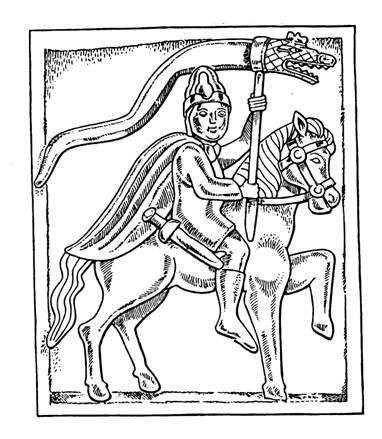 Figure 2: Sarmatian cavalryman.
Artist's rendition of image on Sarmatian stone in Fig. 3.
Sarmatians in Continental Europe.
T. Sulimirski explains, in his article,
[17] that the name
Sarmatia was first used in written texts at the beginning of the Christian era and, before that, they were called Scythians in the Eastern-European region. He believes the Sarmatians to be of Iranian stock and that their language is related to the language of the Avesta.
[18] T. Sulimirsky reminds us of the opinion of Herodotos — who lived in the 5th century B.C — that the Sarmatians spoke a language which was a corrupted variation of the language of the Scythians. Sulimirski believed that no Sarmatian written texts remained, except for some personal names, usually the names of kings. This statement is again the result of silence on the part of the Hungarian Academia.
Sulimirski’s research showed that the western Sarmatians lived within the boundaries of a
very strong central power. Several historical works call them
Royal Sarmatians. He mentions the name of one of their kings,
Galatus, who entered into a treaty with the king of Pontus (today’s Turkey, South of the Black Sea), in 179 B.C. The name of one of their queens,
Queen Amage, was recorded a few decades later. I believe that a similar, very strong central government existed in the Hungarian plains, several centuries B.C., and this made it possible for the Hungarian King István I. (King Stephen I.) to establish his centralized rule through the county system, which must have existed before the time of his reign. The barely 200 years between the “secundus ingressus” of the Seven Dukes under the leadership of Prince Árpád, in the ninth century A.D., and the reign of King István, would not have been sufficient to establish all these without an already existing power base. (The Second Ingress into the Carpathian Basin had been incorrectly termed “Conquest”, possibly in the euphoria of the 1896 celebration of the 1000 year old Roman Christianity in Hungary.)
[19] It also becomes evident that the institution of divine kingship of the Magyars predates King István I. and Christianity. It can be traced through the Royal Scythians into a great antiquity.
According to Sulimirski, the only archaeological remains that can be connected with the Sarmatians are the silver gilded phalerae from the second century B.C. They have embossed ornaments, either geometrical or in animal-style, reminiscent of ancient Assyrian and
Ionian works. We find the same
Sarmatian-Ionian artistic connections at the Sarmatian memorial stone in England too. Sulimirski also mentions that the clothing and armaments of the Sarmatians (Roxolani) are the same on Trajan’s column and on the Arch of Galerius in Saloniki.
He also talks about the
Aorsi under the title of
Masters of the Central Steppes: the Eastern Sarmatians. The Aorsi lived East of the river Volga and were their most distant group. One of their branches settled West of the Volga at the lower end of the Don; these he believes to be fugitives of the central region. In my opinion, based on the meaning of the word
Aorsi, that corresponds with the Magyar word
őrs (sentry) they were not fugitives, but guardians of the outer regions, as their name implies. This opinion is also supported by the fact that fugitives could not possibly have commanded a vast army, which in fact was greater than that of the mother country, as was the fact in this case.
A second group of the Sarmatians were the
Siraces of the Kuban region, who lived more toward the Southern regions in the valley of the Kuban and the neighboring steppes. According to Strabo, their king, Abeacus, commanded only 20,000 horsemen around 66-63 B.C., while Spadines the King of the Aorsi, who was their northern neighbor, commanded a cavalry 200,000 strong . The Sarmatians represented a very significant military might. In the first century A.D., they lost their leading position within the Eastern Sarmatian nations and were supplanted by the
Alans.
Sulimirsky believes the history of the
Iazygs to be largely unknown, but he still identifies them with the
Royal Sarmatians. They were allies of Mithridates Eupator of Pontus, in his fight with Rome. The Romans were waging a punitive war against the Iazygs in 78-76 B.C., north of the Danube. This was probably the first of the many such border conflicts that followed. The Iazygs became well-known enemies of Rome. After 20 A.D., a branch of the Iazygs crossed the Carpathians and settled in the Great Plains of Hungary, between the Dunaon (Danube) and the Tisza rivers, thus joining their indigenous Jász brethren. They still reside in the same place under the name of Jász and are part of the Magyar language and culture, just as much as they were in the previous centuries. A Jász movement in Hungary during the 1930’s aspired to legalize their indigenous status in the region (
Pesti Hirlap, June 21, 1931, Sunday edition).
As we continue to follow the history of the Sarmatians, we find them making peace with Marcus Aurelius in 175 A.D. who, following the treaty, adopted the cognomen Sarmaticus and claimed victory on his freshly minted coins. This “peace” had harsh consequences for the Sarmatians. They were required to live away from the Danube and to render 8,000 cavalrymen to Roman service. Out of these 5,500 were sent to Britannia, where they were divided into groups of 500 and were placed at the northern borders of England. As we know from Sulimirsky, they formed the Roman sixth legion in England. Three excavation sites prove their presence there. One is near the wall of Hadrian, at the stronghold of Chester, where an eye-shield from a horse was found, believed to be of Sarmatian origin, because the shape of the pearls found in this grave has its only counterpart in the Sarmatian graves of Hungary. There is also a funeral stele at Chester, showing a Sarmatian horseman and, in the ancient fort of Brementennacum at Ribchester near Lancaster, inscriptions bear witness to a Sarmatian cavalry unit 500 men strong.
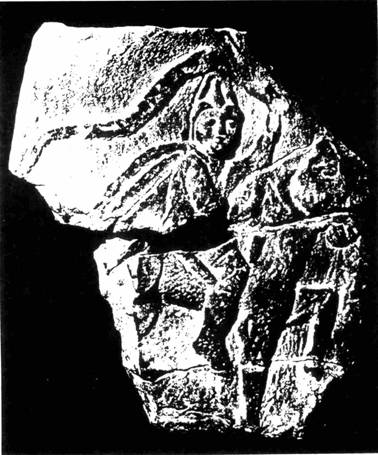
Figure 3. Sarmatian cavalryman
Nothing is known about the fate of these men. Some of them might have returned home. Some of the veterans established themselves near Brementennacum. This settlement never became a town, in the real sense of the word, but still existed in the fifth century A.D. The river names of the Sarmatian-Iazyg regions merit notice, such as the name of the Don in England, the Duna (Danube) in Hungary and the Don in Russia. The common denominator of these names is the presence of a Magyar culture sphere in these regions. The Sarmatian, Iasi, and, in general, the peoples inhabiting Pannonia were in close contact with one another, not only in the Hungarian Transdanubia and the British Isles in Roman times but, as we shall see, they were also in close cultural contact in even more ancient times.
In Pannonia, the skirmishes with Rome still continued. Without doubt, they were a strong nation over whom Rome could never claim permanent victory. No freshly arrived wanderers could have withstood the might of Rome, which was after all in their close proximity. Only a strong central government of the Duna region could accomplish this defense with extensive fortifications, the remains of which are still visible in Hungary. The largest of such fortifications is in the town of Bény
[20]; its quadruple rings date to pre-Avar times, another ring to Aurelian times and so on. The sagas of the indigenous population remember, even today, that Marcus Aurelius began to write his Meditations here.
Prof. Gyula Mészáros, Turkologist, published a short article in 1937, concerning the discord between the Romans and the Iazig
[21]: “We can read about the Jazyg battle of Emperor Constantine in the year 359, in the history books of Ammianus Marcellinus. The Emperor came from his winter camp at Sirmium and organized his troops at Aquincum near the Danube against the limigates who were liberated from serfdom. The Jazygs, faced with the Romans, feigned defeat and promised to be faithful subjects and asked to be permitted to go to the other side of the Danube. The Emperor had a platform built to give a speech to his subjects to be. He almost began to speak, when an irate Jazyg warrior took off his boot and threw it toward the Emperor, calling out: “Marha-marha” words which Ammianus believed to be their battle cry.
[22] This Jazyg “battlecry” means “(You) Ox, (you) Ox” in Magyar. Even in the distant past, this word for bovines had already attained its secondary meaning: “You idiot!”. (The Magyar word
marha in Old Iranian is “mahrka”, in Ossetian: “margä”). Historian Edward Gibbon also mentiones this episode.
[23]In the Iazyg territories, a new object appears in the graves: the so-called
herdsman’s bag — still part and parcel of the Magyar shepherds’ accoutrements, containing an assemblage of tools, such as an iron knife, iron awl, fire-stone and flint and sometimes a whetstone. The ruling class continued to be buried in barrow-graves, of which a notable example has been found at the town of
Szil, in the center of Roman Pannonia. It is possibly the grave of a Sarmatian Prince, who fell in battle during an incursion in the second century A.D. The struggle against the Romans went on through the end of the fourth century A.D. In the early fifth century came the Huns. In 472, the Sarmatians were defeated by Theodoric, King of the Visigoths. The two Sarmatian kings,
Beukan and
Babai, fell in battle. The first name, which was preserved by non-Magyar speaking historians as Beucan, is written and pronounced as
Bőkan in Magyar. The meaning of the components of this word are “rich, abundant” for “bő” and “male” for “kan”, which fully describes the qualities both of a king and of the man. The name
Babai is still a part of the list of Magyar family names and can be found in any Hungarian telephone book.
Sulimirski also shows several Sarmatian tamga signs. Here we find one created with
punched dots similar to those in the script found on the Sarmatian memorial near Hever castle in England. This technique still survives in Hungary, where some use it even when they write with a pen on paper to decorate the outlines of either script or graphics.
Sarmatians in Hungary
As we have noted, in the above historical sources, the name of the Sarmatians and the Iazyg are often interchanged. First I shall bring data concerning the Iazyg-Ion-Jász people in Pannonia and follow the Sarmatians with the help of linguistics later.
The study by historian, Géza Alföldi,
[24] discusses the Roman
civitates in Pannonia: ”It is a well known fact that the middle of Southern Pannonia or, more closely, the region of Siscia Poetovio and Sirmium-Mursa (the Hungarian town Eszék), and the territories bordering Lake Balaton and the Száva river valley are very poor in Roman inscriptions, so we hardly know anything of this large region of Pannonia during the Roman age. There were no significant excavations in this territory. East of Aquae Iasae and west of the town Sirmium (today Szerém in Hungarian), the territory between the Drava and Száva is terra incognita, archaeologically speaking, not to mention the Hungarian territories from Lake Balaton on to the Dráva river, where organized archaeological explorations will be a task of the future.
The large Roman grave-altar, which we will discuss further, is not a recent find and its inscription was also published. The stone was found in 1920 at Daruvár. Its first publication was done by Gj. Szabó [...] whose study was published in 1934.[...]
[25]“The text appeared in the original publication as below”— writes Prof. Alföldi:
“DM / AEL. L. FIL./ AELIANO.
SCRI / BAE. DEC. IIIVIR. / M.IASORUM. / AN. XLV. AEL /LAELIANUS / PATRI PIISIMO/ F.C.”
“We had an opportunity to study the inscription personally during the summer of 1962 in the Zagreb Archaeological Museum. The correct reading of the text is the following:
D(id) M(anibus). / P(ublio) Ael(io) P(ubi) fil(io) / Aeliano scri / bae dec(urioni) IIIIvir(o) / m(unicipii) Iasorum / an(norum) XLV. Ael(ius) / Laelianus / patri piissimo / f(aciendum) c(uravit).
It is not difficult to find an approximate date of the inscription. The name
A.P. Aelius indicates that the citizenship of the deceased municipal officeholder was of Hadrianic origin. The father of
P. Aelius Aelianus also held this citizenship, as the filiation attests to this fact. The naming of the filiation does not permit dating the stone monument later than the middle, or the middle of the second half, of the second century AD; the carving of the capital letters and the beautiful workmanship of the side panels, showing the figures of Attis, also support the fact that this stone originated sometime in the Antonine age. It seems most appropriate to date this stone to the middle of the second century AD, or in other words, it dates around the time of Antonius Pius, which of course does not exclude the possibility that it had been erected already at the time of Hadrianus (Hadrian) or Marcus.
The grave-altar offers significant data about the historically little known
Iasi, which was the
largest indigenous community of Pannonia. The Iasi community was originally one of the Pannonian groups and was in close relationship with other Pannonian peoples such as the
Andizetes, Breuci, Daesitiates, Maezaei[26], and so on. (This last hyphenation is from the author). We are not familiar with the history of these peoples during Roman times but it seems very possible that the Iasi did take part in the great south Pannonian wars and that they were foremost in the Pannonian-Dalmatian insurrection of the 6th through the 9th century AD. After the conquest, this ethnic group formed an administrative unit under the name of Civitas Iasorum, the extent of which was undoubtedly large. According to Plinius (Pliny), the river Dráva flows through it, and according to this information, the Iasi populated parts of Croatia and the Hungarian Transdanubia.
Toward the West, the civitas almost reached Poetovio.
East of Poetovio lies the settlement of Aquae Iasae (Varazdinske Toplice), that originally had belonged, without doubt, to the Iasi territory and only later was annexed to the colony of Poetovio.
The southern border of the civitas lay between the Dráva and Száva. The southern neighbors of the
Iasi were the Celtic
Varciani and the Pannonian
Oseriates, while the
Breuci lived south-east of them.
To the east, the neighborhood of Daruvár was still
Iasi territory. This is evident, not only from the inscription
municipium Iasorum,[27] which we already mentioned, but from all the other inscriptions which were found at Daruvár and known from earlier days. They also mention a
res publica Iasorum.The eastern border of the civitas was identical with the border that separated Pannonia Superior from Pannonia Inferior in Trajan’s time. According to Ptolemaios (Ptolemy) the Iasi lived in the central region of the Eastern part of Pannonia Superior, and their eastern neighbors, the Andizetes, were already settled in Pannonia Inferior.
You can draw the borders of the two Pannonian provinces with a straight line, running from the north to the south, starting at the north-eastern end of Lake Balaton straight down to the lower section of the river Batinus (Bosna), and so the Iasi territory even extended east of Daruvár.
The northern borders of the civitas may be extended all the way to Lake Balaton and it is certain that the hill region of county Somogy was still
Iasi territory.
The civitas
Iasorum was the largest among the
indigenous Pannonian civitates.[....]
[In the region of the Aqua Balissae, or Aqua Balizae] inscriptions were found in earlier times which mentioned a
res publica Iasorum in the years of Septimius Severus in the third century AD.
The autonomy of the Daruvár settlement can still be proven in another way. A Roman inscription in the city of Rome called this settlement
Aquae Balizae, which suggests that this Aquae Balissae covered a very large territory... The place of origin of a third century AD eques singularis, Ulpius Cocceius, is mentioned on this inscription as follows:
ex Pan(nonia) sup(eriore) natus ad Aquas Balizas pago Iovista vic(o) Coc[co]netibus. The
Pagus Iovista is none other than the administrative district of the settlement of
Iovia near the Dráva east of
Aquae Iasae.
The aforementioned municipal
decurio known from Aquae Isae was probably a civil servant of the Daruvár municipium and we know his title from another inscription at Varazdinske Toplice, where the most likely reading is the following: dec(urio)
muni[c(ipii) Iasorum]... The Iasi are mentioned by Plinius (Pliny) and Ptolemaios (Ptolemy) among the civitates. According to Ptolemaios (Ptolemy), they lived in the eastern half of central Pannonia Superior, north of the Oseriates, which corresponds with the already known facts
[28]. Among the authors of antiquity, the
Iasi are mentioned only by Stephanos Byzantios
[29].
The border of the Breuci and the Oseriates was the river Batinus (Bosna), and for this reason, we have to search farther east for the latter community, as was already done and, at the same time, we may extend the Varciani territory to the east of Siscia too.
[30]The identification of Iovia is not absolutely certain. There is mention of two Iovias: one on the road between Poetovio-Mursa, the other between Poetovio and Luntulis. In our view, it is possible that there were more than one Iovia stations, thus, the one under consideration would be the
Iovia, mentioned first.”
*
It is important to note that Alföldi considers the Iasi as indigenous Pannonian people. Since historians alternately write about the 5,500 Iazyg and Sarmatians respectively who were stationed in England during the time of Marcus Aurelius we have to include them among the Pannonian population. The cultural admixture of the Celts and Sarmatians -- considering their close proximity in Pannonia -- may have already begun here. It is also here that many of the Arthur and Holy Grail related geographical names must have had their origins and they were transplanted from here to the British Isles.
Adorján Magyar quotes from the work of István Gyárfás
The History of the Jász-Kun (Vol.I. page 298) concerning the Jász: “Ptolemaios (Ptolemy), when listing the peoples of Pannonia, places the
Jassius people into the vicinity of Sabaria (Szombathely). The Hungarian National Museum exhibits a Roman stone which was excavated in the old Savaria, today’s Szombathely, where the inscription reads
Lucius Savariensis Jon”. Also, Gyárfás quotes István Bizanti, writing the following in 1694:
“Jas, part of Illuria, its inhabitants are the
Jata; it is also called
Jonika.” Furthermore quoting this new Greek Grammaticus he says the following: “Mursa, the city of
Jonika built by Adrianus.”...On another Roman stone, which was excavated near the old Mursa and today’s city of Eszék, dating from before 192 A.D., the inscription reads: ’Divo Comodo
Respublica Jasoru.’ The
Ias (Jász) lived in Transdanubia and Slavonia and they were also known as
Ias (Jász) and
Jon (Jón) or
Jónika, Jónia. We also know that in earlier days the
Ias (Jász) lived in Erdély:Transylvania and Moldova too. Gyárfás states the following: “Near Várhely, on an excavated Roman stone, which dates to the time of Antonius Pius, around the year 140 A.D., the following text may be read besides others:
’...pro saluta et felici Pont., Max. et Anniae Faustinae Aug. Coniugi C. Clod. VI. Praef. M. Dacorum Jassiorum hanc statuam is Auroria numinibus’, etc. and, on a second stone with Greek inscription and a third stone with Latin inscription we read:
“Axius Aelianus Jonius’ which lets us know that the Dák-Jász lived in Erdély (Transylvania) or Moldova (Moldavia) in 153 A.D and that the
Ionius (Jonius) and the
Jassius (Jassius) is the very same
Ias (Jász) nation.
[31]”
One example of the spread
of the Ias-Sarmatian culture sphere toward the West.
About fifty miles from Berlin in the town of Vettersfelde, an important find was excavated. It was published by Dietrich von Bothmer, curator of the Greek and Roman Art at the Metropolitan Museum of New York. Although he did not establish the origin of the find with certainty, he tentatively ranks it with Scythian gold artifacts, dated to the fifth century A.D.
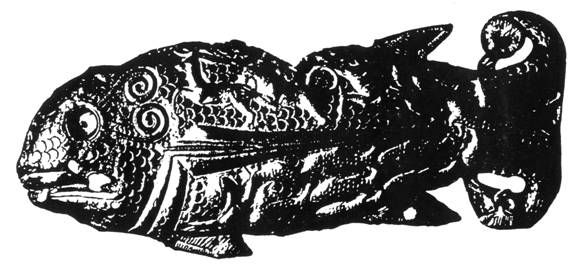
Figure 4. The Vettersfelde find
The object depicts the symbolic animal of the Jász (Iasi), a fish that is called
jizéter in their dialect. The scales of this fish appear to form pale, grayish-white stars and, for this reason, it became the symbol of the Milky Way in the mythology of these seafaring people. The scale armor used by the Jász underlined this mythology.
[32] On the fish in the Vettersfelde find, the scales of the Jász armor are emphasized along with the holy symbol of the Magyar mother culture: the Miracle Stag. The gills of the
jizéter (sturgeon in the Jász dialect)
[33] display the spiral, which is a symbol representative of the Székelys (Siculi). This symbol was part of their designs in Transylvania from the early Stone Age on and its migration can be followed from here to the early Aegean cultures
[34]. Out of this Székely
kusza motif “grew everything”, thus representing the spiral arms of our galaxy. There is rarely a Székely carving to this day that does not contain this design. The Vettersfelde find is a beautiful summation of the mythology of three Magyar ethnic groups: the Jász, the Székely and the Magyar, and proves their presence before the fifth century A.D. in Europe.
Notes[1] Encyclopaedia Britannica Vol.10:208
[2] Prof. Tibor Baráth The Early Hungarians In The Light Of Recent Historical Research, Montreal, 1983
[3] See the letter of the funding father of the Hungarian Academy of Sciences, Prince István Széchenyi in Appendix VI.
[4] A hunok és nagykirályaik
[5] Susan Tomory Magyar-English word origins. Manuscript, 1986
[6] Published by Heraldika Publishers, Budapest, 2004
[7] See Appendix I. for further accounts.
[8] See details in the Appendix I.
[9] See the inscriptions and their translations in Appendix I.
[10] See Appendix I. for details
[11] See Appendix I.
[12] Weltgeschichte Leipzig, 1896 vol.II. page 770
[13] ibid. page 580
[14] Magyar, Adorján Az ősműveltség (The Ancient Culture), page 848
[15] Magyar Adorján Az ősműveltség (The Ancient Culture) pg. 386
[16] Magyar, Adorján Az ősműveltség (The Ancient Culture) 373
[17] Sulimirsky A Once Mighty Folk Scattered Among The Nations
[18] The life work of the Hungarian Alexander Csoma de Körös, creator of the first Tibetan English dictionay
in the 19th century contains significant studies concerning the relationship between the Sanskrit and the Magyar language.
[19] Dr. Tibor Baráth loc.cit pp. 225-231
[20] Now within the borders of Slovakia
[21] Jazyg Nyelvemlékek Magyarországon (Jazyg linguistic remains in Hungary), published at the Szegedi Alföldkutató Bizottság Könyvtára (Társadalom és néprajzi) Szakosztály Közleményei no. 31.
[22] Ammianus Marcellinus Rerum Gestarum L.XIX, 11 (’marha marha’, quod est apud eos signum bellicum...) See Appendix VII.
[23] Edward Gibbon The History of the Decline And Fall Of The Roman Empire, chapter XIX, § 48
[24] Journal of Archaeology Budapest, 1964 2nd issue
[25] GJ Szabó “Iz proslati Daruvara I okdice” in Narodna Starina 28(1943)79. This was quoted in the Journal of Archaeology 1964. 2nd. issue, page 219
[26] The Maezaei (today’s spelling: Mezei) is a common Hungarian name in the present. The Magyar word
mező means meadow in English.
[27] Compare the location of the uninhabited territories of the quoted English references with the territory of
the Municipium Iasorum.( ST.)
[28] Mócsy, A., Die Bevölkerung von Pannonien bis zu den Markomannenkriegen. (Bp., 1959)
[29] Mayer, A., Die Sprache der alten Illyrier I. Wien, 1957
[30] Alföldi, G., Acta Arch.Hung.12[1960] 363
[31] Magyar, Adorján Az Ősműveltség (The Ancient Culture) page 384
[32] Magyar, Adorján Az ősműveltség (The Ancient Culture), pp.- 316-334 Jász chapter.
[33] Magyar Adorján Az Ősműveltség (The Ancient Culture) page 348 Jász chapter
[34] Tomory, Susan Kezdeteink (Our beginnings), publ. Miskolci Bölcsész Egyesület, 2000
by Susan V. Tomory
.