Wednesday, October 11, 2006

Indigenous Religion Of Arabia And The Pagan Arab Pantheon


RELIGION OF PAGAN ARABIA

The Islamic sources do tell us that the pre-Islamic Arabs were mushriks (polytheists) “addicted” to worshipping numerous idols. But they do not inform us as to what those idols symbolized. The Qur’ãn (2.257, 259; 4.52; 53.19; 71.21) mentions some idols but only to denounce them. We reproduce below what Ibn Ishãq writes about them:

“They say that the beginning of stone worship among the sons of Ishmael was when Mecca became too small for them and they wanted more room in the country. Everyone who left the town took with him a stone from the sacred area to do honour to it. Wherever they settled they set it up and walked round it as they went round the Ka‘ba. This led them to worship what stones they pleased and those which made an impression on them. Thus as generations passed they forgot their primitive faith and adopted another religion for that of Abraham and Ishmael. They worshipped idols and adopted the same errors as the peoples before them. Yet they retained and held fast practices going back to the time of Abraham, such as honouring the temple and going round it, the great and little pilgrimage, and the standing on ‘Arafa and Muzdalifa, sacrificing the victims, and the pilgrim cry at the great and little pilgrimage, while introducing elements which had no place in the religion of Abraham. Thus, Kinãna and Quraysh used the pilgrim cry: ‘At Thy service, O God, at Thy service! At Thy service, Thou without an associate but the, associate Thou hast. Thou ownest him and what he owns.’ They used to acknowledge his unity in their cry and then include their idols with God, putting the ownership of them in His hand…1

“The people of Noah had images to which they were devoted. God told His apostle about them when He said: ‘And they said, Forsake not your gods; forsake not Wudd and Suwã‘ and Yaghûth and Ya‘ûq and Nasr. And they had led many astray.’

“Among those who had chosen those idols and used their names as compounds when they forsook the religion of Ishmael-both Ishmaelites and others-was Hudhayl b. Mudrika b. Ilyãs b. MuDar. They adopted Suwã‘ and they had him in RuhãT; and Kalb b. Wabra of QuDã‘a who adopted Wudd in Dûmatu’l-Jandal…

“An‘um of Tayyi’ and the people of Jurash of MadhHij adopted Yaghûth in Jurash.

“Khaywãn, a clan of Hamdãn, adopted Ya‘ûq in the land of Hamdãn in the Yaman.

“Dhû’l-Kalã‘ of Himyar adopted Nasr in the Himyar country.

“Khaulãn had an idol called ‘Ammanas in the Khaulãn country…2

“The B. Milkãn b. Kinãna b. Khuzayma b. Mudrika b. Ilyãs b. MuDar had an image called Sa‘d, a lofty rock in a desert plain in their country…

“Daus had an idol belonging to ‘Amr b. Humama al-Dausî.

“Quraysh had an idol by a well in the middle of the Ka‘ba called Hubal. And they adopted Isãf (or Asãf) and Na’ila by the place of Zamzam, sacrificing beside them…3

“Every household had an idol in their house which they used to worship. When a man was about to set out on a journey he would rub himself against it as he was about to ride off: indeed that was the last thing he used to do before his journey; and when he returned from his journey the first thing he did was to rub himself against it before he went in to his family…

“Now along with the Ka‘ba the Arabs had adopted Tawãghît, which were temples which they venerated as they venerated the Ka‘ba. They had their guardians and overseers and they used to make offerings to them as they did to the Ka‘ba and to circumambulate them and sacrifice at them. Yet they recognized the superiority of the Ka‘ba because it was the temple and mosque of Abraham the friend (of God).

“Quraysh and the B. Kinãna had al-‘Uzzã in Nakhla, its guardians and overseers were the B. Shaybãn of Sulaym, allies of the B. Hãshim…

“Al-Lãt belonged to Thaqîf in Tã’if, her overseers and guardians being B. Mu‘attib of Thaqîf.4

“Manãt was worshipped by al-Aus and al-Khazraj and such of the people of Yathrib5 as followed their religion by the seashore in the direction of al-Mushallal in Qudayd.6

“Dhû’l-KhalaSa belonged to Daus, KhaTh‘am, and Bajîla and the Arabs in their area in Tabãla…

“Fals belonged to Tayyi’ and those hard by in the two mountains of Tayyi’, Salmã and Aja’.

“Himyar and the Yamanites had a temple in San‘ã called Ri’ãm.

“RuDã’ was a temple of B. Rabî‘a b. Ka‘b b. Sa‘d b. Zayd b. Manãt b. Tamîm…

“Dhû’l-Ka‘abat belonged to Bakr and Taghlib the two sons of Wã’il and Iyãd in Sindãd…”7

Hishãm bin Muhammad al-Kalbî (d. AD 819) wrote a whole book, Kitãb al-ASnãm,8 describing what tribe worshipped what idol, at what place, and in what manner. But he did not know what those idols stood for. F. Krenkow comments: “From the description of the idols worshipped by the pre-Islamic Arabs, enumerated by Ibn al-Kalbî, the word Sanam appears to apply to objects of very varying character. Some were actual sculptures like Hubal, Isãf and Nãi’la; so were the other idols set up round the Ka‘ba… Others were trees like al-‘Uzzã and many were mere stones like al-Lãt. Stones are well-known as objects of worship by the Semites in general and the traditionist al-Dãrimî states early in the first chapter of his Musnad that in the time of paganism the Arabs, whenever they found a stone remarkable for its shape, colour or size, set it up as an object of worship. Ibn al-Kalbî states that the Arabs were not content with setting up stones for idols, but even took such stones with them on their journeys…”9

This portrait of the pagan Arabs as primitive fetishists would have remained fixed for all time to come but for the non-Islamic sources which have been studied in recent times. The discovery of numerous inscriptions, particularly in South Arabia, has forced even Muslim scholars to revise their opinion to a certain extent. Shaikh Inayatullah writes:

“These Arabian deities, which were of diverse nature, fell into different categories. Some of them were personifications of abstract ideas, such as jadd (luck), sa‘d (fortunate, auspicious), riDã’ (good-will, favour), wadd (friendship, affection), and manãf (height, highplace). Though originally abstract in character, they were conceived in a thoroughly concrete fashion. Some deities derived their names from the places where they were venerated. Dhu al-KhalaSah and Dhu al-Shara may be cited as examples of this kind.

“The heavenly bodies and other powers of nature, venerated as deities, occupied an important place in the Arabian pantheon. The sun (shams, regarded as feminine) was worshipped by several Arab tribes and was honoured with a sanctuary and an idol. The name ‘Abd Shams, ‘Servant of the Sun,’ was found in many parts of the country. The sun was referred to by descriptive tides also, such as shãriq, ‘the brilliant one.’ The constellation of the Pleiades (al-Thurayya), which was believed to bestow rain, also appears as a deity in the name ‘Abd al-Thurayya. The planet Venus, which shines with remarkable brilliance in the clear skies of Arabia, was revered as a great goddess under the name of al-‘Uzza, which may be translated as ‘the Most Mighty.’ It had a sanctuary at Nakhlah near Mecca. The name ‘Abd al-‘Uzza was very common among the pre-Islamic Arabs. The Arabian cult of the planet Venus has been mentioned by several classical and Syriac authors.”10

The pre-Islamic Arab religion was, however, far more profound. As in the case of every pagan people, the pagan Arabs perceived divinity in everything in their environment, terrestrial as well as celestial. This will become clear as we take up the Arab Gods and Goddesses, one by one. Here we want to mention that the Minaeans, the Sabaeans and the Nabataeans worshipped more of less the same divinities, mostly under the same, though sometimes differing, names.

“First of all,” writes H. Hommel, “as regards the religion of the South Arabians, as we find it in their inscriptions, it is a strongly marked star-worship, in which the cult of the moon-god, conceived as masculine, takes complete precedence of that of the sun, which is conceived as feminine. This is shown in the clearest fashion by the stereotyped series of gods (Minaean: ‘Athar, Wadd, Nakruh, Shams; HaDramawtic: ‘Athar, Sîn, Hol, Shams; Qata-bãnian: ‘Athar, ‘Amm, Anbai, Shams; Sabaean: ‘Athar, Hawbas, Al-mãku-hû, Shams); here we find throughout, a. ‘Athar (the planet Venus conceived as masculine… as symbol of the sky) the god of the heavens mentioned first, b. Wadd or as the case may be, Sîn, ‘Amm or Hawbas the real chief god i.e. the moon; c. Nakruh (the planet Saturn or Mars), or Hol, Anbai (messenger of the gods, Nebo) or Almãku-hû, his (the moon’s) servant or messenger, and finally, d. Shams, the daughter of the moon-god to whom women may have appealed by preference and who therefore stands at the end of the whole enumeration. Besides these, a certain part was played by a great Mother-goddesses, the mother and consort of the moon-god conceived as a personified lunar station, the Minaean Athirat, who was called Harimtu among the Sabaeans and who was in all probability universally known as Ilãt (e.g. as a component part in names of persons, also in the shortened form Lãt). We may also mention various lesser ‘Athar deities (confined later to the part played by Venus as morning or evening star), and among the West Sabaeans Ta’lab, a god of the bow who also bears merely the epithet Dhû Samawî ‘lord of the heaveans’, and to whom especially camels (ibil) are ,sacred (hence in Midian but probably in South Arabia Habul or Hubal etc.). It is a particularly favourite mode of thought to conceive the two chief aspects of the moon (waxing and waning moon) as twin deities, in which connection sometimes the one and sometimes the other phase is specially favoured according to the locality…”11

He continues: “In North West Arabia from Mekka onwards to Petra and further onwards to the Syrian desert (Palmyra) and the Hawrãn, the same ideas prevailed, partly even appearing under the old names partly with new designations. Here we have especially to do with the cults of Mekka and of the whole Hidjãz shortly before Muhammad (al-Lãt and Hubal, in certain cases also al-Lãt, and Wudd, in addition al-‘Uzzã, a feminine form of… Aziz-Lãt, the goddess of death Manãt, a god RuDã and others) and at an earlier period the still more important cult of the Nabataeans. Among the latter also we find the moon divided into twin deities: Dhû Sharã (‘He of the mountain’) and his Kharishã (the sun); the former especially in Petra and Habul (or Hubal) and his consort Manawãt; further also the Mother-goddess Ilãt and a god A‘araã (‘he with the white mark on his forehead,’ originally perhaps only an epithet of Dusares)…”

He concludes: “But we may point out in conclusion that in all probability the Greeks borrowed12 from Arabian incense merchants their Apollo and his mother Leto as also Dionysos and Hermes, in the same way as they took their additional letters Phi, Chi and Psi from the South Arabian alphabet… This would seem to prove definitively that South Arabian civilization with its gods, incense altars, inscriptions, forts and castles must have been in a flourishing condition as early as the beginning of the first millennium BC.”13

Being at par with or even superior to the Greek pantheon, the Arab pantheon acquires a prestige which is seldom conceded to it except by scholars who have studied the subject. One reason is that the literature in which the Greek Gods and Goddesses figure has survived to a large extent, while the pre-Islamic Arab literature has disappeared more or less completely, so much so that even specialists find it difficult to believe that the pagan Arabs had any literature at all. Secondly, the Renaissance in Europe has restored the prestige of the Greek heritage, while people who feel the same pride in the pre-Islamic Arab heritage have yet to come foreward.

The Pagan Arab Pantheon

Now we can take up, in greater detail, individual Arab Gods and Goddesses, starting with the one who presided over the pantheon.

Al-Lãh

The name Allãh has become so much identified with Islam as to rule out any suspicion that he was the Great God of the pagan Arabs. “Allãh, in the Safã inscriptions, Hallãh, ‘the god’, enters into the composition of numerous personal names among the Nabataeans and other Northern Arabs of an early period e.g. Zaid Allãhî, ‘increase of God’ (that is increase of the family through the son given by God), ‘Abd Allãhî, and so forth. Among the heathen Arabs Allãh is extremely common, both by itself and in theophorous names. Wellhausen cites a large number of passages in which pre-Islamic Arabs mention Allãh as a great deity; and even if we strike out certain passages (for instance on the ground that the text has been altered by Muhammadan scribes) so many still remain over, and so many more which are above suspicion can without difficulty be found, that the fact is clearly established. Moreover, Allãh forms an integral part of various idiomatic phrases which were in constant use among the heathen Arabs. Of special importance is the terminology of the Qur’ãn, which proves beyond all doubt that the heathen Arabs themselves regarded Allãh as the Supreme Being. The Nabataen inscriptions mention repeatedly the name of a deity accompanied by a title ‘Alãhã, ‘the god’.”14

The Qur’ãn (13.17;29.61, 63;41.24;39.39; 43.87) itself provides ample evidence that the pre-Islamic Arabs regarded Allãh as “the creator and supreme provider” and “assigned to him a separate position distinct from that of all other deities (6.137).” Here it becomes difficult “to distinguish between their views and the interpretation of their views adopted by Muhammad, especially their vocabulary and that of Muhammad. It will be seen, then, that whatever may have been the origin of the names applied, the religion of Mecca in Muhammad’s time was far from simple idolatry.” Both sides seem to say the same things about Allãh. “But though the name was the same for the Meccans and for Muhammad, their conception of the bearer of the name must have differed widely. The Meccans evidently had in general no fear of him; the fear of Allãh was an element in Muhammad’s creed… The Meccans did not hesitate to disregard him and to cultivate the minor gods; Muhammad knew him as a jealous and vindictive sovereign who would assuredly judge and condemn in the end…”15

It is significant that while the sources, Islamic as well as others, mention idols of many Gods and Goddesses in the Ka‘ba and elsewhere, they nowhere mention an idol of Allãh. The only explanation is that every God and Goddesses was seen by the pagan Arabs as representing Allãh who could be prayed to through any one of them. In fact, the Meccans pointed out to Muhammad (Qur’ãn 6.149; 37.68) that “Allãh had never forbidden them to worship other gods with him.”16 Ibn Ishãq reports that ‘Abdu’l-Muttalib “stood by Hubal praying to Allah.”17 The Qur’ãn is never tired of saying that those whom the idolaters associate with Allah will not intercede for them on the last day. For the pagan Arabs, however, Allãh is no other than his associates; he is them and they are he. Of course, the pagans have no notion of the last day when alone Allãh will visit them; instead, they are aware of him every moment of their lives. He is present not in some high heaven but in and around them, in many names and forms. The character which the Qur’ãn assigns to Allãh must have looked like a prison-house to the pagan Arabs; their Allãh could not be contained in concepts created by the external and shallow mind of man, nor was he helplessly dependent upon the services of a prophet.

The pagan poets “had already developed in Arabic a vivid power of wielding descriptive epithets vis-a-vis Allãh.”18 Many of the ninety-nine names (Asmã’al-Hûsnã) which Muslim theologians mention, can be found in pagan poetry. Most probably, Allãh had many more names, may be a thousand, in the pagan parlance. It has been characteristic of pagan spirituality everywhere that it adorns with numerous names and forms whatever it adores. Muhammad retained only those names which did not offend his monotheism, and dropped the rest. He also added names which did not square with the pagan perception of Allãh but which went very well with the Allãh of his conception. Al-MuTakabbir, the Haughty, looks like one such name. Al-Muntaqîm, the Avenger, is another. The most typical of Muhammad’s contributions, however, is al-Mughnî, the Enricher, that is, by means of booty which includes, we may remember, the women and children of those who become victims of Jihãd. Small wonder that one of the names of Muhammad’s Allãh is al-Zãrr, the Distresser. We find that the Qur’ãn (58.11) uses the same name for Satan. As we shall see, that is exactly what Allãh came to mean in the doctrine as well as the history of Islam.

The two names, ar-RaHmãn, the Compassionate, and al-RaHîm, the Merciful, are the most frequent in Muhammad’s usage. They stand at the head of every Sûra of the Qur’ãn except one. There is nothing intrinsically offensive in these names when applied to Allãh. In fact, they are more appropriate for the Allãh of the pagan Arabs than for the Allãh of Islam. Yet the Meccans found them the most objectionable. Muhammad had tacked them to Allãh while dictating to ‘Ali the draft of the treaty at Hudaybiya. The Meccan representative protested and had them dropped. “Then the apostle,” narrates Ibn Ishãq, “summoned ‘Ali and told him to write ‘In the name of Allah the Compassionate, the Merciful.’ Subayl said ‘I do not recognize this; but write ‘In thy name, O Allah.’ The apostle told him to write the latter and he did so.”19 This was not the only occasion when the Meccans showed their repugnance for these names. They had all along accused Muhammad of importing alien names and imposing them upon Allãh. To them these names were Jewish and the Jews had been in league with Muhammad so far as Arabia’s ancient religion and culture were concerned. They saw these names as symbols of the new-fangled creed which Muhammad was trying to foist on them. On the other hand, Muhammad insisted on using these names because, in his mind, they embodied all that he stood for.

Incidentally, “Traditions assign two hundred names to Muhammad.”20 It seems that the Prophet grew in size at the expense of Allãh who was made to look smaller and smaller. That was quite in keeping with the Prophet’s own image of himself. He was out to block everyone else’s access to Allãh while proclaiming himself as Habîb Allãh, an-Nabî, ar-Rasûl and Khãtim al-Anbiyã. So it was no more sufficient that one believed in Allãh; one had also to believe in Muhammad as the only channel through which Allãh’s will could be known. It was inevitable that, in due course, the Prophet became more important than the contrived god in whose name he spoke.

Al-Malik

There were other deities “whose titles themselves seem to designate them as occupying a position of supreme importance in the eyes of the worshippers.” Al-Malik, ‘the King,’ was the name of such a deity. “In the days of Islãm, al-Malik became one of the epithets of Allãh, and hence the name ‘Abd al-Malik survives among Muhammadans.”21

Ba‘l or Ba‘al

“The divine title Ba‘l or Ba‘al, ‘the lord,’ which was very common among the Northern Semites, survived among the Arabs of the Sinai Peninsula in the form al-Ba‘lû which occurs in their inscriptions together with the proper names ‘Abd al-Ba‘lî, Aus al-Ba‘lî, ‘gift of the Lord,’ and Garm al-Ba‘lî, probably ‘act of the Lord.’ A trace of the worship of this god may be found in Sharaf al-Ba‘l, the name of a place between Medina and Syria. The Arabs of later times were not aware that any such deity had existed, but certain phrases in their language clearly prove that he had once been known. Thus the term ‘soil of Ba‘l’ or simply ‘Ba‘l’ is applied to land which does not require irrigation, but has an underground water supply, and therefore yields fruit of the best quality. In this case the god seems to be regarded as the lord of the cultivated land… Again, the verb ba‘la and other derivatives of Ba‘l mean ‘to be bewildered,’ properly ‘to be seized by the god Ba‘l’.”22

El

“Among the Northern Arabs of early times, particularly in the region of Safã, the word El, ‘God,’ was still very commonly used as a separate name of the Deity. It is true that it does not actually occur except in compound proper names of persons, Wahb El, and many others. Some of these such as Wahbîl, ‘gift of El,’ Abdîl, ‘Servant of El,’ appear among the Arabs of a later age but at least in certain cases they must have been borrowed from the Sabaean language, while in other cases they are restricted to the extreme north of Arabia. It may be added that the divine name Iayãl, which occurs once in an ancient verse, is possibly a plural of majesty formed from El; Uwãl is a variation of the same name.23

“The names commonly used in dynasties, or distinguished families, who originally came from districts where Sabaean or some other peculiar dialect of southern Arabia was spoken, had naturally a tendency to spread among the Arabs in general.”24

Al-Lãt

“The Sun-god who according to Strabo (784) was held in especial honour by the Nabataeans, is very probably to be identified with Allãt… We have already seen that the sun is properly feminine in Arabic and in most other Semitic languages; hence the name Allãt which so far as we can judge means simply ‘the Goddess,’ is particularly suited in this case.” The Greek historian, Herodotus, mentions an Arabian Goddess named Alilãt. “That Alilãt is identical with Allãt, a goddess frequently mentioned, has long been an acknowledged fact. References to Allãt were found in several Nabataean inscriptions; in one of them she is called the ‘Mother of Gods.’ Moreover, proper names compounded with Allãt appear both among the Nabataeans and the Palmyrenes… Among the later Arabs this goddess was no less venerated. In the Qur’ãn (liii.50) she is one of the three daughters of Allãh. She is also mentioned occasionally in poetry. Thus one poet says: ‘I swear to him, in the presence of the throng, by the salt, by the fire, and by Allãt who is the greatest of all.’ Of the names compounded with Allãt, which were widely diffused, some at least must be of considerable antiquity …The cult of the goddess flourished, in particular, at the sanctuary of Tã’if, a town to the east of Mecca; the tribe of Thaquîf, who dwelt in that district spoke of her as the ‘mistress’,”25 that is, al-Rabba.26 Among the Lihyan, a branch of the Hudhail, settled in the country north-east of Mecca, Allãt was worshipped “alongside typically Arab” deities. 27

Manãt

“Some Arabian deities were originally personifications of abstract ideas… Time in the abstract was popularly imagined to be the cause of all earthly happiness and especially of all earthly misery. Muhammad in the Qur’ãn (Sûra xlv. 23) blames the unbelievers for saying, ‘It is Time that destroys us.’ Her main sanctuary was a black stone among the Hudailîs in Qudaid, not far from Mecca on the road to Medina near a bill called Mushallal. She was however worshipped by many Arab tribes, primarily the Aws and Khazradj in Yathrib.28 In Mecca she was very popular along with the goddesses al-Lãt and al-‘Uzzã; the three (according to the Qur’ãn) were regarded as Allãh’s daughters, and in a weak moment Muhammad declared their worship permitted (cf. Sûra liii. 19 sqq.)… According to Ibn al-Kalbî, she was the oldest deity whose worship gave rise to that of the others, because names compounded with Manãt occur earlier than other theophoric names. Another view is found in Ibn Hishãm, p.145, where ‘the two daughters of ‘Uzzã are Manãt and al-Lãt.’ As an independent deity we find her in the Nabataen inscriptions of al-Hidjr… Manãt is connected in a peculiar way by some writers with the great hadjdj, for we are told that several tribes including the Aws and Khazradj assumed the ihrãm at the sanctuary of Manãt and on conclusion of the rites cut their hair and dropped the ihram…”29

The character of the Goddess can be inferred from her name. In Arabic manîya (plural, manãya) means “the alloted, fate, doom of death, destruction”. Manãt, therefore, was primarily the Goddess of Time. “The poets are continually alluding to the action of Time (dahr, zamãn) for which they often substitute ‘the days,’ or ‘nights.’ Time is represented as bringing misfortune, causing perpetual change, as biting, wearing down, shooting arrows that never miss the mark, hurling stones, and so forth… Occasionally we come across such passages as the following: ‘Time has brought woe upon him, for the days and the (alloted) measure (qadar) have caused him to perish.’ Various expressions are used by the poets in speaking of the ‘portion’ alloted to them or the goal that is set before them… Once we meet with the phrase ‘till it be seen what the Apportioner shall apportion to thee’ (mã yamnî laka ’lamãnî), which apparently refers to a god… The word here translated ‘apportion’ originally means ‘to count’, hence to ‘reckon’ a thing to someone…”30

She is also the Goddess of Death. “Manîya appears in poetry as driving a man into the grave, piercing him with an arrow, handing to him the cup of death, lying in ambush for him, receiving him as a guest (when he is about to die), and so forth. Not unfrequently the possessive suffix is added, ‘when my Manîya overtakes me,’ ‘his Manîya has come upon him,’ and the like…”31

Al-‘Uzzã

Her name means ‘the Most Mighty.’ She was a Goddess of the Sabaeans who, in due course, became popular all over Arabia. She embodied the cult of the planet Venus. “The Syrian poet Issac of Antioch, who lived in the first half of the 5th cent., bears witness to the worship of ‘Uzzã by the Arabs of that period; in another passage he identifies ‘Uzzã with the planet Venus… The Arabian cult of the Venus is mentioned like-wise by Ephrahim Syrus (who died in AD 373), by Jerome, Theodret, and later still by Evagrius… As early as the 2nd cent. or thereabout, references to a priest of this goddess occur in two Sinaitic inscriptions… Another Sinaitic inscription mentions the name ‘Abd al-‘Uzzã which at a later time, just before the rise of Islam, was extremely common among the Arabs… ‘Uzzã figures in the Qur’ãn (Sûra liii. 19) as one of the three great goddesses of Mecca, who were supposed to be daughters of Allãh. That Muhammad himself offered sacrifices to her in his younger days is expressly stated by tradition…

“Kuthrã which probably means ‘die Most Rich,’ the name of an idol destroyed by order of Muhammad, is perhaps only another title of ‘Uzzã. We also read of a man call ‘Abd Kuthrã, belonging to the tribe of Tai, in the very centre of Arabia. Here the absence of the definite article proves that the name Kuthrã is ancienl”32

Another poet is known to have sworn by the Sa‘ida (Blessed) ‘Uzzã. As as-S‘ida is known to be the name of a Goddess worshipped at Medina, it is inferred that she was ‘Uzzã. “She was especially associated with the GhaTafãn but her principal sanctuary was in the valley of the Nakhla on the road from Tã’if to Mecca… It consisted of three samura (acacia) trees in one of which the goddess revealed herself… From these centres her cult spread among a number of Beduin tribes, the Khuzã’a, Ghanm, Kinãna, Balî, Thakîf and especially the Quraish, among whom she gradually acquired a predominant position… Here she formed with al-Lãt and Manãt a trinity in which she was the youngest but came in time to overshadow the others… When in the year 3, Abû Sufyãn set out to attack Muhammad he took the symbols of al-‘Uzzã and al-Lãt with him. That of the two al-‘Uzzã was the more important as the patron deity of Mecca is shown from Abû Sufyãn’s war cry: al-‘Uzzã is for us and not for you…

“Her cult disappeared after this [destruction of her sanctuary], as did the numerous proper names, combinations of al-‘Uzzã, while the masculine counterpart ‘Abd al-‘Azîz remained because ‘Azîz was one
of the names of Allãh…”33

Shams

“The Sun (Shams, construed as feminine) was honoured by several Arabian tribes with a sanctuary and an idol. The name ‘Abd Shams, ‘servant of the Sun,’ is found in many parts of the country. In the North we meet with the name Amrishams, ‘man of the Sun’…

“For the worship of the rising Sun we have the evidence of the name ‘Abd ash-Sharîq, ‘servant of the Rising One’… In the extreme South there was a God called DharîH or DhirrîH, which appears likewise to denote the rising Sun… Once we meet the name ‘Abd Muharriq; here Muharriq, ‘the Burner,’ may perhaps be another title of the Sun-god. The Muharriq who is mentioned as the ancestor of certain royal houses admits of a similar explanation.”34

Sûra 91 of the Qur’ãn is named Ash-Shams. The word “shams” survives in Muslim names also.

Dhu’sh-Sharã

He was an ancient Arab deity. “According to the Arab tradition he was a god who owned a reserved grazing ground (Himã) among the Dawsites with a hollow in which the water trickled down from the rocks, which is in agreement with the fact that the name ‘Abd Dhu ‘l-Sharã is found in this tribe. According to al-Kalbî also, this deity was worshipped among the related Banu ’l-Hãrith… We meet with Dh ’l-Sharã (Dusares) on more historical ground as a the chief god of the Nabataeans in whose inscriptions from Petra, the land east of Jordan and as far as al-Hidjr, he is often mentioned. His chief sanctuary was in Petra where a large black, quadrangular stone was dedicated to him in a splendid temple. He had another important sanctuary in Soada which was called Dionysias after him. His festival was celebrated here in August which is certainly connected with the fact that he was identified with Dionysos as the god of fertility, particularly of the vintage. In Petra and Elusa, on the other hand, his festival, according to Epiphanius, fell on the 25th day of December on which day ‘the virgin called Kkhbou in Arabic and Dusares born of her were worshipped with Arabic hymns’… It naturally reminds one of the Arabic ka‘ab ‘a young maiden with breasts developed’; but it is also possible to connect it with ka‘b ‘cube’ (cf, the Ka‘ba at Mecca) according to which interpretation the god was thought to have been born from the stone.”35

“…But there were several places called ash-Sharã, and the difficulty of determining with which of them the god was originally connected is increased by the fact that his cult goes back to very early times. The localities which bear this name appear to have been moist and rich in vegetation; such a spot, in the midst of a sterile country like Arabia, easily became a centre of worship.” The fact that underneath his idol “stood a golden pedestal, and the whole sanctuary blazed with gold and votive offerings”, as also the fact that his festival fell “about the time of the winter solstice”, establish his “connexion with Sun-worship”. He was the “patron of luxuriant vegetation”, which further emphasism his “character as a Sun-god.”36

“Another god who appears to have been named after a place is Dhu ’l-Halasa or Dhu ’l-HulaSa. He was greatly venerated at a place in the noth of Yemen, apparently the district now called ‘Asir. Between his sanctuary and the sanctuary at Mecca there existed a certain amount of rivalry.

“From a grammatical point of view, the gods Dhu ’l-Kaffain, ‘He who has two hands,’ and Dhu’r-rijl, ‘He who has a foot,’ must be classed with the two forgoing ones. Perhaps these names may have been originally applied to sacred stones, which by means of rude carving were made to bear a partial resemblance to the human form.”37

Another God with a similar name was Dhu ’l-KhabSa who was worshipped by al-Azd or al-Asd, “a widely ramified family of tribes” among which “the al-Aws and al-Khazradj of Medina and the Khuzã‘a in and around Mecca were counted.” They were worshippers of Manãt. The same tribe living in the mountains of Sarãt worshipped an idol named ‘Ã’im.38

At-Thuraiyã

“The constellation of the Pleiades (ath-Thuraiyã) which was supposed to bestow rain, appears as a deity in the name ‘Abd ath-Thuraiyã; the name ‘Abd Najm refers also to the Pleiades, for the latter are often called simply an-Najm, ‘constellation.’”39

“The word “thuraiyã” is a dimunitive of “tharwã” which means ‘existing in plenty’… The constellation is so called because rain at its rising at the dawn brings tharwã i.e. great plenty. In any case, from early times the Pleiades have been credited with great influence on weather and the processes of nature dependent upon it… The constellation is also regarded as a diadem with jewels and it is mentioned in countless passages in the poets…”40

The word “thuraiyã” survives in the name Suraiya which is still common among Muslims everywhere. Sûra liii of the Qur’ãn is named An-Najm. Najm and Najmã are also components of Muslim names.

QuzaH

He was an “ancient Arabian thunder-god who shot hail from his bow and then hung the latter on the clouds.” We meet him in the “combination Qaus QuzaH”, the bow of QuzaH, meaning the rainbow.41 QuzaH was also “the name of a certain spot, within the sacred territory of Mecca, where pilgrims were accustomed to kindle fire.”42 The Islamic lore is not quite logical about this God. He is described as a shaiTãn (devil) and also as an angel who looks after the clouds. The rainbow becomes Allãh’s bow, bow of the prophet of Allãh, bow of the heavens, bow of the clouds, signs of heaven, etc., and the word loses its association with a God.

Wadd

“…also pronounced Wudd or Udd i.e. ‘friendship,’ ‘affection,’ was according to the Qur’ãn (Sûra lxxi. 22) a god worshipped by the contempories of Noah. But it would be a mistake to conclude that his worship was obsolete in Muhammad’s time, for we have sufficient evidence to the contrary. The poet Nãbigha says once, ‘Wadd greet thee!’ There was a statue of this god at Dûma, a great oisis in the extreme North of Arabia. The name ‘Abd Wadd occurs in a number of wholly distinct tribes… As we are told that his statue had a bow and arrows attached to it we might be tempted to imagine that he was a kind of Eros, and this would imply a foreign origin. But though the root WDD means ‘to love,’ ‘to feel affection’ for an object, it is never used in a sexual sense. Moreover the statue in question bore not only a bow and arrows, but likewise a sword and lance from which hung a flag; the god was also fully clad and therefore does not look like a copy of the Greek Eros.”43

Ch. Muhammad Ismail mentions an inscription which he saw in the Prince of Wales Museum of Western India, Bombay, in 1921. It was on one of the stones “brought from Aden by Colonel H.F. Jacob of the Indian Army, who was for a long time at Aden…”44 The language of the inscription was “what may be called Himyaritic though Sabaean and South Arabic are also names given to it”. Ch. Ismail read the inscription as saying, “The House No. 2 of Father Wadd”, and commented: “Wadd was a god worshipped by the Arabs who often wore talismans bearing the name Wadd. The word itself is derived from wudd which means love. It was opposed to Nakruh, the god of hatred.”45

The name of this God survives in Al-Wadûd, one of the ninety-nine names of Allãh meaning “the Loving One” (Qur’ãn, xi. 92; lxxv. 14).

RuDã

She was a Goddess who symbolized ‘goodwill’ or ‘favour’. “The commentary on a term in which the name is mentioned informs us that RuDã was worshipped in the shape of an idol by the great tribe of Tamîm. The proper name ‘Abd RuDã is found among several Arab tribes. To the nature of the deity in question the name supplies no clue… The remarkable fact that in the abovementioned verse RuDã is construed as feminine (whereas this grammatic form would normally be masculine), naturally suggests that at that period, about the time of Muhammad, people still realized that RuDã was merely an epithet applied to a goddess who properly bore some other name. But against this hypothesis, it may be urged that the name is of considerable antiquity, as is proved by the Palmyrene inscriptions, where it occurs separately in the form ‘RSU, and in theophorous proper names as RSU… The RDU of the Safã inscriptions seems to denote the same deity.”46

Jadd

It was the name of a deity venerated by various Semitic people. The word occurs in Nabataean inscriptions in the form Gaddã. “But since we meet the proper name ‘Abd al-Jadd in a few cases… and since the noun judd, ‘luck,’ remained in current use among the Arabs, it is more natural to regard the Nabataean Gaddã as an Aramaized form of the native Arabic al-Gadd (al-Jadd).”47 The name is used in the Qur’ãn (lxxii. 3) in the sense of ‘greatness’ and ‘majesty’.

Sa‘d

In Arab astronomy it is the common name for small groups of stars in the constellations Pegasus, Aquarius and Capricorn which augur good fortune. That is what the God Sa‘d stood for. “According to a certain verse and statements of the commentator, Sa‘d was the name given to a rock not far from Jidda, to which divine honours were paid. Moreover, we meet the name ‘Abd Sa‘d in quite a different part of Arabia, to the north-east. At an earlier period a man’s name which seems to be compounded with Sa‘d occurs in the inscriptions of Safã.”48 Three of Muhammad’s leading companions were named Sa‘d- Sa‘d ibn Abî Waqqãs, Sa‘d ibn Mu’az and Sa‘d ibn ‘Ubãdah. The name seems to have survived, though in an abbreviated form, in the title of the thirty-eighth Sûra of the Qur’ãn.

Manãf

The name means ‘height’, or ‘high place’. “That Manãf was worshipped as a god is proved by the testimony of a verse, and is confirmed by the occurrence of a name ‘Abd Manãf which was especially common at Mecca and among the neighbouring tribe of Hudhail.” The word Mãnaphis is found in an ancient inscription from the Haurãn and seems to be derived from Manãphios, the name of this God.49

“…It is said that one of Muhammad’s ancestors-the pedigree being Muhammad b. ‘Abd Allãh b. ‘Abd al-MuTTalib b. Hãshim b. ‘Abd Manãf-received this name because his mother consecrated him to Manãf, who was then the chief deity of Makka.

“… Ibn Kalbî knows nothing of its whereabouts except that menstruating women were bound to keep themselves at a distance from it.

“The name does not occur either in the Qur’ãn or in classical hadith. It derives from a root n-w-f, which in several Semitic languages conveys the meaning of ‘being elevated’.”50

Nasr

It was “One of the idols of ancient Arabs, mentioned in the Qur’ãn, Sûrah lxxi. 23. it was an idol which, as its name implies, was worshipped under the form of an eagle.”51 Muhammad made this God a contemporary of Noah. “But it is to be noticed that the Sabaeans like-wise had a god called Nasr…”52

‘Auf

The name ‘Abd ‘Auf was quite common among the Arabs. ‘Auf means “the great bird of prey”. The word is not found in this form in the Arab language at present. But “the verb ‘afã, which is derived from it, means ‘to wheel in the air,' as birds of prey are wont to do.” The word “has, in particular, the sense of augurium, and it may be that the name of the god did not refer to the bird but to the omen drawn from it; in this case ‘Auf would be a synonymous of Sa‘d.”53

Yagûth

“The god Yagûth, whose name evidently means ‘helper,’ was according to the Qur’ãn (Sûra lxxi. 23), another of the deities worshipped in the days of Noah… We find no trace of this god in early times… But at a later period we hear of a god Yagûth, whose idol was an object of contention among the tribes of Yemen, and the name ‘Abd Yagûth occurs in various part of Arabia, even in the tribe of Taghilib on the north-eastern frontier.”54

“Yagûth had the shape of a lion.”55

Ya‘uq and Suwã‘

The idol of Ya‘uq “"was in the form of a horse, and was worshipped in Yemen. (Bronze images of this idol are found in ancient tombs and are still used as amulets)…

“Suwã‘, in the form of a woman, was said to be from antidiluvian times…”56

“The name of the god Ya‘uq, who is mentioned in the Qur’ãn together with Yagûth, probably means ‘the Preserver’; his cult seems to have been confined to Yemen. Suwã‘, who is also included among gods worshipped by Noah’s contemporaries (Sãrû lxxi. 20), was apparently of no great importance. He had a sanctuary at a place in the territory of the Hudhail, but none, so far as we know, elsewhere. The meaning of his name is altogether obscure. Neither Suwã‘ nor Ya‘uq seems to occur in the theophorous proper names. It is hardly necessary to remark that the transferring of all these Arabian deities to the age of Noah was a fantastic anachronism due to Muhammad himself.”57

Hubal

“Hubal was worshipped at Mecca; his idol stood in the Ka‘ba, and appears to have been in reality, the god of that sanctuary… It would be unsafe to trust the descriptions of the idol in question which are given by writers of a later period; there is reason, however, to believe that the god had a human form. We may likewise accept as historical the statement that near him were kept divining arrows, used for the purpose of ascertaining his will or forecasting future events. It is related that the idol was brought by ‘Amr b. LuHai from Ma‘ãb (Moab), a tradition which may contain some elements of truth, for we have independent evidence indicating that the god was known in the North. He seems to be mentioned in a Nabataean inscription at Hejr; and the tribe of Kalb, who dwelt in the Syrian Desert, used the name of Hubal as the name of a person or clan; the same tribe… used in like manner the names of Îsãf and Nã’ila, two other deities peculiar to Mecca. Moreover, ‘Amr b. LuHai is the representative of the Huzã‘a, a tribe who, according to tradition, occupied the sacred territory of Mecca before it passed into the hands of the Quraish. The assertion that’Amr introduced the worship of idols into Mecca for the first time is, of course, utterly incredible. But the hypothesis that Hubal was a late importation from a foreign country is further supported by the fact that we hear nothing of him in other parts of Arabia, and even at Mecca personal names compounded with Hubal were unknown. When the Meccans gained a victory over the Prophet in the immediate neighbourhood of Medina, their leader shouted, ‘Hurrah for Hubal!’ Thus they regarded him as the natural enemy of the God preached by Muhammad.”58

“Another tradition indeed relates that Hubal was an idol of Banû Kinãna, worshipped also by the Quraish, and had been placed in the Ka‘ba by Khuzaima b. Mudrika wherefore it used to be called Hubal Khuzaima. It is further related that the idol was of red carnelian, in the form of a man; the Quraish replaced the right hand which was broken, by a golden one…”59

“Hubal was in the form of a man and came from Syria; he was the god of rain and had a high place of honour.”60

“An idol, the God of the Moon…”61

“It is remarkable that there is no distinct allusion to the idol in the whole of the Qur’ãn.”62

“The learned Dr. Pocock… derives the name from the Hebrew habba’l or habbe’l and suggests… the appropriateness of havel, ‘vanity!’ Among the Arabs, Hubal seems to have had a double character, in which respect he resembled the Syrian idol Baal (properly, Ba‘al), who was regarded both as the founder of the Babylonian empire, and as the sun personified as a deity. The opinion that Hubal was the same as the Babylonian or Syrian idol Ba‘al or Bêl, or synonymous with it, is in fact supported by the testimony of the Arabian authorities, who relate that it was originally brought from Syria or Mesopotamia. Of course, the Arabian writers do not maintain that Hubal was identical with Ba‘al: they admit, however, that it was an astronomical deity, which Ba‘al also is believed to have been-whose designation, by the way, like that of ‘the sun’ among ourselves, always appears with the article-‘Habba‘al’. Further, Herodotus (and after him, Rawlison) held the opinion that Hubbal was ‘the Jupiter of the Arabians’-presumably because he was believed to have the power of sending rain…”63

Isãf and Nã’ila

Muslim tradition says that “They were a man and woman of Jurhum-Isãf b. Baghy and Nã’ila d. Dîk-who were guilty of sexual relations in the Ka‘ba and so God transformed them into two stones.”64

Obviously the tradition is a fabrication. As pointed out above, the tribe of Kalb in the Syrian Desert worshipped both of them as deities along with Hubal. The idols “stood near Mecca on the hills of Safa and Mirwa; the visitation of these popular shrines is now a part of the Muslim pilgrimage…”65 They were no doubt “two sacred stones, but the origin of their names is so far unexplained.”66

Al-Qais

He was an ancient God of the pagan Arabs. “He must have early disappeared as a deity, for al-Kalbî does not mention him in his Kitãb al-ASnãm and he is not given in the various passages in Arab literature that give lists of the gods of the Djahilîya. But that he was at one time worshipped as a god may be deduced with considerable certainty from the tribal name ‘Abd al-Qais and from the well-known personal and tribal name Imru’ al-Qais.” The name of a God mentioned in the Nabataean inscription from al-Hijr “can hardly be other than an Aramaic adaptation of al-Qais” who “had a sanctuary in al-Hijr in which copies of documents used to be deposited.” The word “qais” carries several meanings in the dictionaries. De Goeje “has deduced the meaning ‘Lord’ from al-Hamdãnî, Djazîrat al-‘Arab.”67

Al-UqaiSir

“…The name of a divinity of pre-Muhammadan Arabia, or better an epithe, the meaning of which (diminutive of aqSar, ‘he who has a stiff neck’ or perhaps simply ‘the short’) seems to indicate an idol in a human shape. All that we know of the god (whose real name is un-known) goes back to the references to him by Ibn al-Kalbî, Kitãb al-ASnãm followed by Yãqût, Mu‘djam… Al-UqaiSir was worshipped by the tribes of QuDã‘a, Lakhm, Djudhãm, ‘Amila and GhaTafãn living on the plateau of the Syrian Desert. Verses in old poets quoted by Ibn al-Kalbî mention stones (anSãb) put up around the sacred place, the ‘garments’ (athwãb), the ditch (djafr) into which were thrown the offerings, the cries and chants of the pilgrims…

“As Wellhausen notes, the expressions used in the verses which Ibn al-Kalbî quotes in connection with al-UqaiSir must refer to a sanctuary as well as to an idol. We might then suppose that the epithet reflects the squat form of the building. It is worthwhile recalling that the name Uqaisir is also applied to a tribe, to individuals and even to a sword.”68

Shai al-Qaum

We learn about this God from a Palmyrene and a Nabataean inscription. He is “the Companion of the people”, “the kind god who rewards (or who is grateful), and who drinks no wine”, that is, “to whom no libations of wine are offered.”69

Duwar

“…was the virgins’ idol and young women used to go around it in procession, hence its name.”70

Conclusion

The deities listed in the foregoing few pages may sound too many to minds under the spell of monotheism. The fact, however, is that they are far too few and represent only what has been salvaged by modern scholarship form the extensive ruins caused by Islam. For the pagan Arabs, the whole of their homeland was honeycombed with temples and sanctuaries housing hundreds of divinities with as many Names and Forms. Every household had its ancestral deities which were joined by those brought in by the brides. Every locality, every oasis, every grove had its own presiding deity. So also every tribal territory. Finally, the national temple, the Ka‘ba at Mecca, had as many as three hundred and sixty deities, the Names and Forms of which remain unknown except in the case of a few. “It seems that in course of time the various Arab tribes had brought in their gods and placed them in the Ka‘ba, which had consequently acquired the character of the national pantheon for the whole of Arabia.”71

The more pertitent point in the present context, however, is that the pagan Arabs were fully satisfied with their ancestral religion and felt no need for a replacement. Of course, they were not in the business of saving souls and civilizing other people, which is what has come to count in the history of religion. But that is a “fault” inbuilt in the very genius of paganism. “Occupied with the reform of their own lives and the righting of actual wrongs, these persons made no noise and being earnest did not suppose that the replacement of one cult for another would make men virtuous; and Mohammed himself had occasion to draw a contrast between the conduct of his pagan and that of his believing son-in-law, greatly to the disadvantage of the latter. So far as the religious sentiment requires gratification, there is no evidence to show that paganism had faded to gratify it. We gather from the inscriptions of the pagan Arabs that a wealth of affection and gratitude was bestowed upon their gods and patrons.”72 In the pagan spiritual tradition people are expected to be “busy with themselves”, that is, busy in improving their own morals by purifying their own consciousness. The prophetic tradition, on the other hand, harangues people to be “busy with the others”, that is, saving other people from sin, infidelity, and the eternal hell-fire. That is why the prophetic tradition abounds in missions and da‘was, crusades and jihãds.

It is often pointed out that no pagan Arab came foreward with a philosophical defence of his religion when it was assailed by Muhammad. The only defence which every pagan put up for his religion was that it was the religion of his forefathers and, as such, hallowed by time and tradition. A deeper reflection goes to show that this was indeed a very strong defence. What the monothesists dismiss as polytheism and idol-worship are natural to the normal human psyche. Moreover, honouring that which was honoured by one’s ancestors keeps one rooted in one’s history and culture. Cults which encourage one to denounce one’s ancestors as barbarians or infidels, and one’s past history as an age of ignorance, render one rootless and make one into a menace to one’s neighbours. The Bible provides ample evidence of the normal people reverting to polytheism and idol-worship again and again, and the persistent and violent wars which the prophets had to wage for reimposing Jehovah on them. In any case, a religion stands in need of a philosophical defence only when it is already on a course of decline, and an inner dissatisfaction starts gnawing at the heart of its more perceptive adherents. There is no evidence that the pagan Arabs were suffering from such a psychosis on the eve of Islam. The confidence with which they spurned Muhammad’s message and ridiculed his superior claims leaves little doubt that Arab paganism was still in a state of good health. Though not so the environment in which this paganism lived and breathed. The mental disorder glorified as monotheism was present in an epidemic form, not only all around it but also in its very midst. Arab paganism was blissfully ignorant of what monotheism meant and the mischief it intended for a society which permitted it to spread.

Footnotes:

1 Ibid., op. cit., pp. 35-36. The word “God” in this passage and those that follow is a translation of the word “Allãh” The references to Abraham and Ishmael and their mode of worship at the Ka‘ba may be ignored in the light of what we have stated above. The Ka‘ba was a temple of the pagan Arabs who had never heard of Abraham or Ishmael or their religion.

2 Ibid., p. 36.

3 Ibid., p. 37.

4 Ibid., p. 38.

5 It was renamed Medina when Muhammad migrated to it.

6 Ibid., pp. 38-39.

7 Ibid., p. 39.

8 Plural of Sanam. Dictionaries and commentaries on the Qur’ãn define it as “an object which is worshipped besides God”, being a thing made of wood, stone or metal.

9 First Encyclopaedia of Islam, op. cit., Vol. VII, p. 147.

10 Shaikh Inayatullah, op. cit., p. 128.

11 First Encyclopaedia of Islam, op. cit., Vol. 1. p. 379. References to similar Gods of other nations, mentioned in parentheses, have been left out.

12 This theory of borrowing Gods in the case of pagan spiritual traditions does not mean much because the pagan psyche throws up spontaneously the same symbols everywhere.

13 Ibid., p. 380.

14 Encyclopaedia of Religion and Ethics, Third Impression, Edinburgh, 1955, Vol. I, p. 664.

15 First Encyclopaedia of Islam, op. cit., Vol. I, p. 302.

16 Ibid.

17 Ibn Ishãq, op. cit., p. 67. Allãh of the pagan Arabs reminds us of the Devãdhideva, the God of Gods, in the Hindu spiritual tradition.

18 First Encyclopaedia of Islam, op. cit., Vol. I, p. 303. Pagan epithets of Allãh remind us of the Sahasranãma-s in praise of many Hindu Gods and Godesses.

19 Ibn Ishãq, op. cit, p. 504.

20 Cyril Glasse, The Concise Encyclopaedia of Islam, London, 1989, p. 279.

21 Encyclopaedia of Religion and Ethics, op. cit., p. 664

22 Ibid. See also the last para under Hubal in this section.

23 Ibid.

24 Ibid., Footnote.

25 Encyclopaedia of Religion and Ethics, op. cit., p. 661.

26 First Encyclopaedia of Islam, op. cit., Vol. VI, p. 1088.

27 Ibid., Vol. V, p. 27. Allãt, reminds us of Aditi, the Mother of Gods in the Vedic pantheon.

28 This city became known as Medina after Muhammad migrated to it from Mecca in AD 622. It remained his seat till his death in AD 632. Later on, it was the capital of the Caliphate till ‘Alî moved to Kufa.

29 Ibid., op. cit., Vol. V, p. 231.

30 Encyclopaedia of Religion and Ethics, op. cit., p. 661.

31 Ibid., One is reminded of the Hindu concept of Kãla which stands for both Time and Death, and parallel verses can be found in Hindu literature. We also know of Hindu temples dedicated to Mahãkãla.

32 Encyclopaedia of Religion and Ethics, op. cit., p. 660.

33 First Encyclopaedia of Islam, op. cit., Vol. VIII, p. 1069.

34 Encyclopaedia of Religion and Ethics, op. cit., p. 660.

35 First Encyclopaedia of Islam, op. cit., Vol. II, p. 965.

36 Encyclopaedia of Religion and Ethics, op. cit., p. 663.

37 Ibid.

38 First Encyclopaedia of Islam, op. cit., Vol. I, pp. 530-31.

39 Encyclopaedia of Religion and Ethics, op. cit., p. 660.

40 First Encyclopaedia of Islam, op. cit., Vol. VIII, p. 740.

41 Ibid., op. cit., Vol. IV, p. 833.

42 Encyclopaedia of Religion and Ethics, op. cit., p. 661. He reminds us of Indra of the Vedic pantheon in one of his roles.

43 Ibid., p. 662.

44 A Himyaritic Inscription’, article by Ch. Muhammad Ismail in Indian Antiquary, Vol. LVI (February, 1927), p. 21.

45 Ibid., p. 22.

46 Ibid.

47 Ibid.

48 Ibid.

49 Ibid.

50 First Encyclopaedia of Islam, op. cit., Vol. V, p. 227.

51 Thomas Patrick Hughes, Dictionary of Islam, First Published 1885, New Delhi Reprint 1976. p. 431.

52 Encyclopaedia of Religion and Ethics, op. cit., p. 663. He reminds us of GaruDa in the PurãNas.

53 Ibid.

54 Ibid.

55 S.M. Zwemer, The Influence of Animism in Islam, New York, 1920, p. 5.

56 Ibid.

57 Encyclopaedia of Religion and Ethics, op. cit., p. 663.

58 Ibid., pp. 663-64. Pagan spiritual traditions elsewhere are also known to have borrowed or exchanged idols. No idol is foreign to the pagan psyche.

59 First Encyclopaedia of Islam, op. cit, Vol. III, p. 327.

60 S.M. Zwemer, op. cit., p. 5.

61 Cyril Glasse, op. cit p. 160.

62 Thomas Patrick Hughes, op. cit., p. 181.

63 The Oracle of Hubal’, article in Indian Antiquary. Vol. XII, (January, 1883), p. 5.

64 Ibn Ishãq, op. cit., p. 37.

65 S.M. Zwemer, op. cit., p. 6.

66 First Encyclopaedia of Islam, op. cit., Vol. III, p. 527. Hindu iconography is familiar with Mithunas. Gods and their Consorts, worshipped together.

67 Ibid., Vol. IV, p. 651. There is considerable inscriptional evidence from South India about the Hindu practice of making various types of agreements in the temples, thus invoking the Gods and Goddesses as witnesses.

68 Ibid., Vol. VIII, p. 993.

69 Encyclopaedia of Religion and Ethcis, op. cit., p. 663.

70 S.M. Zwemer, op. cit., p. 6.

71 Shaikh Inayatullah, op. cit., p. 130.

72 D.S. Margoliouth, op. cit., p. 25.


SITA RAM GOEL, "Hindu Temples, What happened to them", Chapter Eleven


.

Monday, October 09, 2006

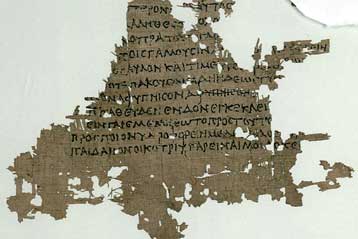
Europe's Oldest "Book" Read With High-Tech Imaging: The Derveni papyrus


Modern imaging technology is resurrecting lost chapters of Europe's oldest surviving "book."


The Derveni papyrus, a fourth-century B.C. religious discourse, was charred in an ancient funeral pyre, making portions of the text unreadable.

Now experts from Brigham Young University in Provo, Utah, are using high-tech methods to expose the blackened script, which could help complete existing partial translations of the document.

An international team funded by the National Geographic Society recently used similar techniques to authenticate the lost gospel of Judas .

Specifically, a technique known as multispectral imaging may be able to reveal as much as 10 or 20 percent of the scorched sections of the Derveni scroll, researchers said last week.

NASA developed multispectral imaging so that telescopes could see through space dust and gases to peer further into the cosmos. The method involves taking multiple images of the same subject using different light wavelengths.

Brigham Young scientists are using the technique to filter out various unwanted light frequencies and find the wavelength that makes black text visible against the darkened background.

Archaeologist Polyxeni Veleni is director of Greece's Archaeological Museum of Thessaloniki, where the manuscript is currently housed.

"We were now able to read even the most carbonized sections, as there were pieces that were completely blackened and nobody could make out whether there were letters on them," he told the Associated Press.

Scroll Saved by Funeral Pyre

The Derveni papyrus dates to about 340 B.C., making it the oldest surviving Greek papyrus.

Images on pottery and other artifacts prove that Greeks used papyrus scrolls even before the fourth century B.C., but no others are known to exist.

The scroll had been buried with its owner, a wealthy Macedonian nobleman, after both were burned on a funeral pyre. The book was charred but not consumed by the flames. The otherwise intact papyrus was unearthed in 1962 near the northern town of Thessaloniki.

Roger Macfarlane, a classicist at Brigham Young, explains that a series of fortunate circumstances, including the scroll's near destruction, allowed it to survive for so long.

Papyruses usually can't endure the vagaries of the European climate, he says.

"It was scorched and dried out [from the funeral pyre]. The carbonization of the papyrus led to its preservation," he said.

"If someone had taken this and put it on a shelf in a library, it wouldn't be around today. None of the [other Greek] papyri from the fourth or fifth centuries B.C. have survived."

The scroll's discovery was also a result of careful excavation—the manuscript had been laid on top of its owner's tomb rather than inside it.

"It took some very careful archaeology to sift through the ground and find this very fragile papyrus and preserve it in an [intact] state" Macfarlane said.

"I think if it had been dropped, it probably would have crumbled into thousands of pieces."


Cult of Orpheus

Dirk Obbink is classics scholar at the University of Oxford in the United Kingdom who has been working with the Derveni papyrus since the 1980s.

The text, Obbink said, is "a philosophical treatise about the nature of the gods and the soul."

He describes a complex document in which the lines between religion, philosophy, and science are often blurred.

"The author considers several authoritative texts … and explains how modern scientific beliefs can be seen even in those older writings to expound his physical view of the world," Obbink said.

The text includes reproduced portions of a poem and original commentary on the poem's content. Both reference the creation of the universe from the viewpoint of the cult of Orpheus.

Orpheus was the legendary Greek musical hero who sailed with the Argonauts and charmed Hades, king of the underworld, with his skill.

The mythical figure gave rise to a cult of religious beliefs that stressed a single creator god rather than the familiar Greek pantheon.

Supporting this idea, the scroll's author suggests that female deities such as Hera—queen of the gods—and Demeter—goddess of the harvest—are "the same she" and even equates the goddesses with the king of the gods, Zeus.

"Some scholars see this [monotheistic belief] as a predecessor to Christianity, a protodevelopment of Christian principles," Brigham Young's Macfarlane said.

"I personally don't see it that way, but it's an interesting interpretation."

The papyrus also has dramatically boosted scholars' understanding of early Greek thinkers, none of whose original work survives.

"We're lucky if we get a [reproduction] quotation from a Roman-period author, and that's usually a lousy paraphrase in the language of the day," Obbink said.

As for the original author, many names have been suggested, but no one really knows the ancient thinker's identity.

"The chances of him having been one of Anaxagoras' circle is pretty good, I'd say," Obbink said.

Anaxagoras was a fifth-century B.C. Athenian philosopher believed to have taught Socrates.


.

Oλοκληρώθηκε η πρώτη πλήρης έκδοση του περίφημου παπύρου του Δερβενίου!


Ολοκληρώθηκε, μελετήθηκε και εκτυπώθηκε η πρώτη πλήρης έκδοση του αρχαιότερου βιβλίου της Ευρώπης, του περίφημου παπύρου του Δερβενίου.

Η παρουσίαση της πρώτης αυτής έκδοσης του κειμένου που έγινε από τους καθηγητές Κυριάκο Τσαντσάνογλου (ομότιμο καθηγητή της κλασσικής φιλολογίας), Θεόκριτο Κουρεμένο (αναπληρωτή καθηγητή της κλασσικής φιλολογίας) και Γιώργο Παράογλου (καθηγητή της παπυρολογίας) θα γίνει την ερχόμενη Πέμπτη στο αρχαιολογικό Μουσείο της Θεσσαλονίκης.

Πρόκειται για τον γνωστό, από το Φεβρουάριο του 1962, πάπυρο με ορφικό κείμενο, που βρέθηκε καμένος στον κιβωτιόσχημο τάφου του Δερβενίου (στον ίδιο όπου βρέθηκε ο εντυπωσιακός χάλκινος κρατήρας με την τέφρα του νεκρού, χρυσό στεφάνι και άλλα σκέυη). Ο πάπυρος φέρεται να γράφηκε στο δεύτερο μισό του 5ου π.Χ αιώνα (πριν από το θάνατο και την καύση του νεκρού που προσδιορίζεται στα 340 π.Χ).

Το κείμενο του παπύρου αποτελεί μια φιλοσοφική πραγματεία δοκιμιακής σχεδόν μορφής, ένα σχόλιο ουσιαστικά πάνω σε ένα ορφικό ποίημα του 5ου π.Χ.

Στο κείμενο αναλύεται η άποψη των ορφικών (φιλοσοφική θεωρία - δοξασία που διαδόθηκε στην Ελλάδα του 6ου π.Χ. από τη Θράκη και συνδέθηκε με τον Θράκα Ορφέα, στο πρόσωπο του οποίου αναγνωρίστηκε ο αρχηγέτης και δημιουργός σειρά επικών ποιημάτων με τον τίτλο «Θεογονίαι») περί της κοσμογονίας, θεογνωσίας, μυστικισμού και θρησκευτικών τελετών, ενώ σύμφωνα με τους μελετητές αποτελεί πρόδρομο του μονοθεϊσμού.

Η ανασύνταξη του βιβλίου υπήρξε επίπονη και χρονοβόρα. Σώθηκαν 266 κομμάτια, το μέγεθος των οποίων κυμαίνεται από αυτό ενός μεγάλου γραμματοσήμου μέχρι αυτό μιας φακής. Τα κομμάτια τοποθετήθηκαν στη σωστή τους θέση δημιουργώντας έναν κύλινδρο μήκους τριών περίπου μέτρων και μέγιστου ύψους 9,5 εκατοστών που περιείχε 26 στήλες κειμένου.

Πρόσφατα μάλιστα την επιχείρηση αποκρυπτογράφησης του κειμένου ανέλαβε πολυμελής επιστημονική ομάδα με επικεφαλής τον Ντερκ Όμπινκ του Πανεπιστημίου της Οξφόρδης, διευθυντή και γενικό εκδότη του σχεδίου για τους παπύρους από τον οξύρυγχο.

Η επιχείρηση ανασύστασης, μελέτης και δημοσιοποίησης του κειμένου, στην οποία μετείχε μάλιστα και ο υφυπουργός Οικονομικών Π.Δούκας, ο οποίος πέραν του προσωπικού ενδιαφέροντος δήλωσε απόλυτος υποστηρικτής του πρωτοποριακού προγράμματος φασματοσκοπικής φωτογράφησης του παπύρου, ενώ με την ιδιότητα του ως μέλος της κυβέρνησης δεσμεύτηκε για την όποια έκτακτη επιχορήγηση χρειαστεί προς το υπουργείο Πολιτισμού, χαρακτηρίστηκε ως μείζον θέμα «εθνικής σημασίας».


news.in.gr


«Γη, Μήτηρ, Ρέα και Ηρα είναι η ίδια. Ονομάστηκε Γη κατά σύμβαση -Γη και Γαία ανάλογα με τη διάλεκτο του καθενός- και Μήτηρ γιατί τα πάντα γεννιούνται απ' αυτή. Και ονομάστηκε Διμήτηρ όπως Γη - Μήτηρ κατ' όνομα από τα δύο γιατί ήταν το ίδιο πράγμα. Είναι ειπωμένο στους ύμνους: Διμήτηρ, Ρέα, Γη, Μήτηρ, Εστία, Δηιώ. Γιατί ονομάστηκε Δηιώ; Επειδή ρημάχτηκε (αδηιώθη) κατά την τεκνοποιία. Και θα γίνει φανερό ότι σύμφωνα με τα έτη γεννά υπερβολικά. Και Ρέα γιατί πολλά και κάθε λογής ζωντανά γεννήθηκαν (εκρέοντας) απ' αυτήν - Ρέα και Ρείη ανάλογα με τη διάλεκτο του καθενός».

Καμένο τμήμα του παπύρου, όπως φαίνεται στον υπολογιστή κατά την πολυφασματική ανάλυση
Είναι ένα μικρό μόνο τμήμα του παπύρου του Δερβενίου, που χρονολογείται στον 6ο π.Χ. αιώνα, είναι γραμμένος στα ελληνικά και αποτελεί το αρχαιότερο κείμενο της δυτικής παράδοσης. Ο συγγραφέας αποδεικνύει ότι οι γυναικείες θεότητες του δωδεκάθεου ήταν στην πραγματικότητα μία και εξηγεί έτσι την κοσμογονία. Αναφέρεται στη θεωρία των προσωκρατικών φιλοσόφων περί μονοθεϊσμού, αλλά αρθρώνει διαφορετική αντίληψη για τον ορφισμό και την κοσμογονία, ακόμη και από τους ίδιους τους ορφικούς. Γι' αυτό άλλωστε το κείμενο έχει τεράστια φιλοσοφική και θρησκειολογική σημασία.

Δείτε και αυτά:

http://www.cambridge.org/uk/catalogue/catalogue.asp?isbn=0521801087
http://en.wikipedia.org/wiki/Derveni_papyrus


.

Thursday, October 05, 2006

MAORI COSMOGONY AND MYTHOLOGY.


About Maori People


Humans did not inhabit New Zealand until around A.D. 800, almost 1,200 years ago. The first people to arrive there were Pacific Islanders, who traveled the seas in giant canoes. Using the stars, sun, and sea currents to navigate and find land, they traveled from island to island. Over a period of 500 years many canoes brought people to Aotearoa, "The Land of the Long White Cloud," as New Zealand was then called. On Colin's journey he met the descendants of those seagoing travelers, who are now known as Maoris.

The Maoris believe in gods which represented the sky, earth, forests, and forces of nature. The Maori people also believe that the spirits of their ancestors could be called upon to help them in times of need or war. The Maori culture is rich with songs, art, dance, and deep spiritual beliefs.


MAORI COSMOGONY AND MYTHOLOGY


THE Maori had no tradition of the Creation. The great mysterious Cause of all things existing in the Cosmos was, as he conceived it, the generative Power. Commencing with a primitive state of Darkness, he conceived Po (=Night) as a person capable of begetting a race of beings resembling itself. After a succession of several generations of the race of Po, Te Ata (=Morn) was given birth to. Then followed certain beings existing when Cosmos was without form, and void. Afterwards came Rangi (=Heaven), Papa (=Earth), the Winds, and other Sky-powers, as are recorded in the genealogical traditions preserved to the present time.

We have reason to consider the mythological traditions of the Maori as dating from a very antient period. They are held to be very sacred, and not to be repeated except in places set apart as sacred.

The Genealogies recorded hereafter are divisible into three distinct epochs:--

1. That comprising the personified Powers of Nature preceding the existence of man, which Powers are regarded by the Maori as their own primitive ancestors, and are invoked in their karakia by all the Maori race;


for we find the names of Rangi, Rongo, Tangaroa, &c., mentioned as Atua or Gods of the Maori of the Sandwich Islands and other Islands of the Pacific inhabited by the same race. The common worship of these primitive Atua constituted the National religion of the Maori.

2. In addition to this the Maori had a religious worship peculiar to each tribe and to each family, in forms of karakia or invocation addressed to the spirits of dead ancestors of their own proper line of descent.

Ancestral spirits who had lived in the flesh before the migration to New Zealand would be invoked by all the tribes in New Zealand, so far as their names had been preserved, in their traditional records as mighty spirits.

3. From the time of the migration to New Zealand each tribe and each family would in addition address their invocations to their own proper line of ancestors,--thus giving rise to a family religious worship in addition to the national religion.

The cause of the preservation of their Genealogies becomes intelligible when we consider that they often formed the ground-work of their religious formulas, and that to make an error or even hesitation in repeating a karakia was deemed fatal to its efficacy.

In the forms of karakia addressed to the spirits of ancestors, the concluding words are generally a petition to the Atua invoked to give force or effect to the karakia as being derived through the Tipua, the Pukenga, and the Whananga, and so descending to the living Tauira.


MAORI COSMOGONY.

Powers
of
Night
and
Darkness.

Te Po (= The Night).
Te Po-teki (= hanging Night).
Te Po-terea (= drifting Night).
Te Po-whawha (= moaning Night).
Hine-ruakimoe
Te Po.

Powers
of
Light.

Te Ata (= The Morn).
Te Ao-tu-roa (= The abiding Day).
Te Ao-marama (= bright Day).
Whaitua (=space).

Powers
of
Cosmos
without
form
and
void.

Te Kore (= The Void).
Te Kore-tuatahi.
Te Kore-tuarua.
Kore-nui.
Kore-roa.
Kore-para.
Kore-whiwhia.
Kore-rawea.
Kore-te-tamaua (= Void fast bound).
Te Mangu (= the black) sc. Erebus.

From the union of Te Mangu with Mahorahora nui-a-Rangi (= The great expanse of Rangi) came four children:--

1. Toko-mua (= elder prop).
2. Toko-roto (= middle prop).
3. Toko-pa (= last prop).
4. Rangi-potiki (= child Rangi).


GENEALOGICAL DESCENT FROM TOKO-MUA.

Powers
of
The Air,
Winds.

Tu-awhio-nuku (= Tu of the whirlwind).
Tu-awhio-rangi.
Paroro-tea (= white skud).
Hau-tuia (= piercing wind).
Hau-ngangana (blustering wind).
Ngana.
Ngana-nui.
Ngana-roa.
Ngana-ruru.
Ngana-mawaki.
Tapa-huru-kiwi.
Tapa-huru-manu.
[1] Tiki.

Human
beings
begin
to
exist.

Tiki-te-pou-mua (The 1st Man).
Tiki-te-pou-roto.
Tiki-haohao.
Tiki-ahu-papa.
Te Papa-tutira.
Ngai.
Ngai-nui.
Ngai-roa.
Ngai-peha.
Te Atitutu.
Te Ati-hapai.
[2] Toi-te-huatahi.
Rauru.
Rutana.

[1. Whose wife was Hine-titamauri de quâ infra.

2. Whose wife was Puhaorangi de quâ infra.]


| Whatonga.
| Apa-apa.
| Taha-titi.
| Ruatapu.
| Rakeora.
| Tama-ki-te-ra.
| Rongo-maru-a-whatu.
| Rere.
| Tata =
| |
| |
| +------------------------------+
| |

| Wakaotirangi.
| Hotumatapu.
| Motai.
| Ue.
| Raka.
| Kakati.
| Tawhao.
| Turongo.
| Raukawa.
| Wakatere.
| Taki-hiku.
| Tama-te-hura.
| Tui-tao.
| Hae.
| Nga-tokowaru.

Rongokako.
Tamatea.
[1] Kahu-hunu.

[1. Tamatea was settled at Muriwhenua, and his son Kahuhunu was born there. The latter went on a journey to Nukutauraua near the Mahia, and there married Rongomai-wahine, having got rid of her husband Tamatakutai by craft. Tamatea went to bring him home, but on their return their canoe was upset in a rapid, near where the river Waikato flows out of the lake Taupo, and Tamatea was drowned.]


| Huia.
| Korouaputa = Rakumia (f.).
|
+-----------+----------------------+
| |

Pare-wahawaha (f.) = Te Rangipumamao Parekohatu =
| |
Tihao = TE RAUPARAHA.
|
+-------------------------+
| |
Te Whata-nui = Kotia (f.)=
| |
Tutaki = TE NGARARA.
|
HINEMATIORO.

GENEALOGICAL DESCENT FROM TOKO-ROTO.

Powers
of the
Heavens.

Rangi-nui.
Rangi-roa.
Rangi-pouri.
Rangi-potango.
Rangi-whetu-ma.
Rangi-whekere.
Ao-nui.
Ao-roa.
Ao-tara.
Urupa.
Hoehoe.
Puhaorangi (f.).

After the birth of Rauru, the son of Toi-te-huatahi and Kuraemonoa, while Toi was absent from home fishing, Puhaorangi came down from Heaven, and


carried off Kuraemonoa to be his own wife. She bore four children from this union:--

1. Ohomairangi.

2. Tawhirioho.

3. Ohotaretare.

4. Oho-mata-kamokamo.

From Ohomairangi descended:--

Time of
Migration
from
Hawaiki.

Muturangi.
Taunga.
Tuamatua.
Houmaitahiti.
Tama-te-kapua.
Kahu.
Tawaki.
Uenuku.
Rangitihi.
Ratorua.
Wakairikawa.
Waitapu
Hine-rehua.
To Kahu-reremoa.
Waitapu.
Parekawa.
To Kohera.
Pakaki =

|
+----------------------------+
| |
To Rangi-pumamao = Parewahaika = Te Whata
| |
+------+ +-----------------+
| | |
Tihao. Tokoahu. Tuiri.
Kotia. Hihitaua. Waho (f.).
TE NGARARA. To Tumuhuia TE HIRA.
or
TARAIA.


GENEALOGICAL DESCENT FROM TOKO-PA.

Kohu (=Mist) was the child of Tokopa.

Kohu married To Ika-roa (= The Milky-way), and gave birth to Nga Whetu (= The Stars).

GENEALOGICAL DESCENT FROM RANGI-POTIKI.

Rangi-potiki had three wives, the first of which was Hine-ahu-papa; from her descended:--

Sky
Powers

Tu-nuku.
Tu-rangi.
Tama-i-koropao.
Haronga.

Haronga took to wife Tongo-tongo. Their children were a son and daughter, Te Ra (= The Sun) and Marama (= The Moon). Haronga perceiving that there was no light for his daughter Marama, gave To Kohu in marriage to Te Ikaroa, and the Stars were born to give light for the sister of To Ra, for the child of Tongo-tongo. "Nga tokorua a Tongotongo" (= the two children of Tongotongo) is a proverbial term for the Sun and Moon at the present day.

Rangi-potiki's second wife was Papatuanuku. She gave birth to the following children:--

Rehua (a star).
Rongo.
Tangaroa.
Tahu.
Punga and Here, twins.
Hua and Ari, do.

Sky Powers.


Nukumera
Rango-maraeroa

twins.

Marere-o-tonga
Takataka-putea

do.

Tu-matauenga
Tu-potiki

do.

RONGO was atua of the kumara.

TANGAROA was ancestor of Fish and the Pounamu, which is classed with fish by the Maori. Tangaroa took to wife Te Anu-matao (= the chilly cold): from which union descended.

All
of the
Fish
Class.

Te Whata-uira-a-tangaroa.
Te Whatukura.
Poutini.
Te Pounamu.

TAHU was atua presiding over peace and feasts.

PUNGA was ancestor of the lizard, shark, and ill-favoured creatures: hence the proverb "aitanga-a-Punga" (= child of Punga) to denote an ugly fellow.

TU-MATAUENGA was the Maori war God.

Rangi-potiki's third wife was Papa (= Earth). Tangaroa was accused of having committed adultery with Papa, and Rangipotiki, armed with his spear, went to obtain satisfaction. He found Tangaroa seated by the door of his house, who, when he saw Rangi thus coming towards him, began the following karakia, at the same time striking his right shoulder with his left hand:--

Tangaroa, Tangaroa,
Tangaroa, unravel;
Unravel the tangle,
Unravel, untwist.

Though Rangi is distant,
He is to be reached.
Some darkness for above,
Some light for below
Freely give
For bright Day[1]

This invocation of Tangaroa was scarce ended when Rangi made a thrust at him. Tangaroa warded it off, and it missed him. Then Tangaroa made a thrust at Rangi, and pierced him quite through the thigh, and he fell.

While Rangi lay wounded he begat his child Kueo (= Moist). The cause of this name was Rangi's wetting his couch while he lay ill of his wound. After Kueo, he begat Mimi-ahi, so-called from his making water by the fireside. Next he begat Tane-tuturi (= straight-leg-Tane), so-called because Rangi could now stretch his legs. Afterwards he begat Tane-pepeki (= bent-leg-Tane), so-called because Rangi could sit with his knees bent. The next child was Tane-ua-tika (= straight-neck Tane), for Rangi's neck was now straight, and he could hold up his head. The next child born was called Tane-ua-ha[2] (= strong-neck-Tane), for Rangi's neck was strong. Then was born Tane-te-waiora, (= lively Tane), so called because Rangi was quite recovered. Then was born Tane-nui-a-Rangi (= Tane great son of Rangi). And last of all was born Paea, a daughter. She was the last

[1. This karakia is the most antient example of the kind. It is now applied as suggestive of a peaceable settlement of a quarrel.

2. Ha = kaha.]


of Rangi's children. With Paea they came to an end, so she was named Paea, which signifies 'closed.'

Some time after the birth of these children the thought came to Tane-nui-a-Rangi to separate their father from them. Tane had seen the light of the Sun shining under the armpit of Rangi; so he consulted with his elder brothers what they should do. They all said, "Let us kill our father, because he has shut us up in darkness, and let us leave our mother for our parent." But Tane advised, "Do not let us kill our father, but rather let us raise him up above, so that there may be light." To this they consented; so they prepared ropes, and when Rangi was sound asleep they rolled him over on the ropes, and Paea took him on her back. Two props were also placed under Rangi. The names of the props were Tokohurunuku, and Tokohururangi. Then lifting him with the aid of these two props, they shoved him upwards. Then Papa thus uttered her farewell to Rangi.

"Haera ra, e Rangi, ê! ko le wehenga taua i a Rangi."

"Go, O Rangi, alas! for my separation from Rangi."

And Rangi answered from above:

"Heikona ra, e Papa, ê! ko te wehenga taua i a Papa."

"Remain there, O Papa. Alas! for my separation from Papa."

So Rangi dwelt above, and Tane and his brothers dwelt below with their mother, Papa.

Some time after this Tane desired to have his mother Papa for his wife. But Papa said, "Do not turn your inclination towards me, for evil will come to you. Go to your ancestor Mumuhango." So Tane took {p. 21} Mumuhango to wife, who brought forth the totara tree. Tane returned to his mother dissatisfied, and his mother said, "Go to your ancestor Hine-tu-a-maunga (= the mountain maid)." So Tane took Hine-tu-a-maunga to wife, who conceived, but did not bring forth a child. Her offspring was the rusty water of mountains, and the monster reptiles common to mountains. Tane was displeased, and returned to his mother. Papa said to him "Go to your ancestor Rangahore." So Tane went, and took that female for a wife, who brought forth stone. This greatly displeased Tane, who again went back to Papa. Then Papa said "Go to your ancestor Ngaore (= the tender one). Tane took Ngaore to wife. And Ngaore gave birth to the toetoe (a species of rush-like grass). Tane returned to his mother in displeasure. She next advised him, "Go to your ancestor Pakoti." Tane did as he was bid, but Pakoti only brought forth hareheke (= phormium tenax). Tane had a great many other wives at his mother's bidding, but none of them pleased him, and his heart was greatly troubled, because no child was born to give birth to Man; so he thus addressed his mother--"Old lady, there will never be any progeny for me." Thereupon Papa said, "Go to your ancestor, Ocean, who is grumbling there in the distance. When you reach the beach at Kura-waka, gather up the earth in the form of man." So Tane went and scraped up the earth at Kura-waka. He gathered up the earth, the body was formed, and then the head, and the arms; then he joined on the legs, and patted down the surface of the belly, so as to give the form of man; and when he had done this, he returned to his mother and said, "The


whole body of the man is finished." Thereupon his mother said, "Go to your ancestor Mauhi, she will give the raho.[1] Go to your ancestor Whete, she will give the timutimu.[2] Go to your ancestor Taua-ki-te-marangai, she will give the paraheka.[3] Go to your ancestor Punga-heko, she has the huruhuru." So Tane went to these female ancestors, who gave him the things asked for. He then went to Kura-waka. Katahi ka whakanoho ia i nga raho ki roto i nga kuwha o te wahine i hanga ki to one: Ka man era. Muri atu ka whakanoho ia ko to timutimu na Whete i homai ki waenga i nga raho; muri atu ko to paraheka na Taua-ki-te-marangai i homai ka whakanoho ki to take o to timutimu: muri iho ko to huruhuru na Pungaheko i homai ka whakanoho ki runga i to puke. Ka oti, katahi ka tapa ko Hineahuone. Then he named this female form Hine-ahu-one (= The earth formed maid).

Tane took Hine-ahu-one to wife. She first gave birth to Tiki-tohua--the egg of a bird from which have sprung all the birds of the air. After that, Tikikapakapa was born-a female. Then first was born for Tane a human child. Tane took great care of Tikikapakapa, and when she grew up he gave her a new name, Hine-a-tauira (= the pattern maid). Then he took her to wife, and she bore a female child who was named Hine-titamauri.

One day Hine-a-tauira said to Tane, "Who is my father?" Tane laughed. A second time Hine-a-tauira asked the same question. Then Tane made a sign:[4]

[1. 2. 3. Quaedam partes corporis genitales.

4. Katahi ka tohungia e Tane ki tona ure.]


and the woman understood, and her heart was dark, and she gave herself up to mourning, and fled away to Rikiriki, and to Naonao, to Rekoreko, to Waewae-te-Po, and to Po.[1] The woman fled away, hanging down her head. [2]Then she took the name of Hine-nui-te-Po (= great woman of Night). Her farewell words to Tane were--"Remain, O Tane, to pull up our offspring to Day; while I go below to drag down our offspring to Night."[3]

Tane sorrowed for his daughter-wife, and cherished his daughter Hinetitamauri; and when she grew up he gave her to Tiki to be his wife, and their first-born child was Tiki-te-pou-mua.[4]

The following narrative is a continuation of the history of Hinenuitepo from another source:--

After Hinenuitepo fled away to her ancestors in the realms of Night, she gave birth to Te Po-uriuri (= The Dark one), and to Te Po-tangotango (= The very dark), and afterwards to Pare-koritawa, who married Tawaki, one of the race of Rangi. Hence the proverb when the sky is seen covered with small clouds "Parekoritawa is tilling her garden." When Tawaki climbed to Heaven with Parekoritawa, he repeated this karakia.:--

Ascend, O Tawaki, by the narrow path,
By which the path of Rangi was followed;
The path of Tu-kai-te-uru.

[1. These were all ancestors of the race of Powers of Night.

2. He oti, ka rere te wahine: ka anga ko te pane ki raro, tuwhera tonu nga kuwha, hamama tonu te puapua.

3. "Heikona, e Tane, hei kukume ake i a taua hua ki te Ao; kia haere au ki raro hei kukume iho i a taua hua ki te Po."

4. Vid. Genealogical Table.]


The narrow path is climbed,
The broad path is climbed,
The path by which was followed
Your ancestors, Te Aonui,
Te Ao-roa,
Te Ao-whititera.
Now you mount up
To your Ihi,
To your Mana,
To the Thousands above,
To your Ariki,
To your Tapairu,
To your Pukenga,
To your Whananga,
To your Tauira.

When Tawaki and Parekoritawa mounted to the Sky, they left behind them a token--a black moth--a token of the mortal body.

Pare gave birth to Uenuku (= Rainbow). Afterwards she brought forth Whatitiri (= Thunder). Hence the rainbow in the sky, and the thunder-clap.


EDWARD SHORTLAND

Wednesday, October 04, 2006

Σελήνη - Εκάτη - Άρτεμις


«Ορθή, ως σύννεφο γυμνή και ονειροπόλα μέσα εις την ολόχρυση ωχρότητά της
Που την αντανακλά το φουσκωμένο κύμα της μακριάς, κυανής της κόμης,
Μέσα εις του δρυμού το ξέφωτο όπου αστροσκορπίζονται τα βρύα
Κοιτά η Δρυάς τον σιωπηλό ουρανό.
-Διστακτική, η πάλλευκη Σελήνη αφήνει τον πέπλο της να κυματίζεται
Εις του Ωραίου Ενδυμίωνος τα πόδια,
Και του αποθέτει το ηδύ της φίλημα με μίαν χλωμήν αχτίδα.
»
Αρθρούρος Ρεμπώ

Ο Ήλιος, ο Ωκεανός και η Τηθύς είναι κάποιες από τις προολύμπιες θεότητες που εξακολούθησαν να λατρεύονται με ιδιαίτερες τιμές από τους ανθρώπους ακόμη και μετά την εγκαθίδρυση της κυριαρχίας του Διός και της Αρμονίας εις τον Κόσμο. Ο Ήλιος είναι υιός της Τιτανίδος Θείας (θεϊκής) και του Τιτάνος Υπερίωνος (αυτού που ευρίσκεται υψηλά). Σύζυγος του Ηλίου είναι η Θεά Πέρση, ή Περσηίς της οποίας το όνομα φαίνεται να συνδέεται με αυτό της Θεάς Περσεφόνης. Ο Ήλιος, εις τον ελληνικό Μύθο, είναι, όπως μας πληροφορεί ο Κερένυϊ, γενάρχης και σοφός Θεός. "Ακόμη και σήμερα", γράφει ο Κερένυϊ, "όταν οι Έλληνες ομιλούν για την δύση του Ηλίου, λένε χαρακτηριστικά πως ο Ήλιος βασιλεύει". Εις την αρχέγονη μάλιστα παράδοση συναντούμε και μία Θεά Ηλία, μητρική θεότητα που αποτελεί το θηλυκό αντίστοιχο του Ηλίου.

Ο Ήλιος έχει δύο αδελφές. Η μία είναι η Θεά της αυγής, η Ηώς, και η άλλη είναι η νυκτερινή Θεά Σελήνη. Όπως είναι βεβαίως αυτονόητο, οι Θεοί Ήλιος και Σελήνη δεν ταυτίζονται με τα αντίστοιχα ουράνια σώματα. Οι Έλληνες ήσαν άριστοι αστρονόμοι και ουδέποτε θεοποίησαν ουράνια σώματα. Δυνάμεθα όμως να πούμε πως οι Θεοί αυτοί είναι και οι ίδιοι που ορίζουν τα ουράνια σώματα εις τα οποία δανείζουν τα ονόματά τους. Έτσι ο Ήλιος, ο Θεός ο οποίος ορίζει τον ήλιο που μας φωτίζει και που αποτελεί προϋπόθεση της θνητής ζωής μας είναι επίσης ο Θεός ο οποίος ορίζει τους ήλιους όλων των ηλιακών συστημάτων του Σύμπαντος, όσων έχουν ήδη γεννηθεί, όσων τώρα γεννούνται και όσων θα γεννηθούν εις το μέλλον. Σύμφωνα προς την πιο διαδεδομένη πλέον άποψη, μία σχέσις στενής συγγένειας ή και ταυτότητος κάποτε συνδέει τον Ήλιο με τον Απόλλωνα και την Σελήνη με την Αρτέμιδα. Ενδεχομένως ο Ήλιος και η Σελήνη να εκφράζουν τα τιτανικά αντίστοιχα των δύο αδελφών, του Απόλλωνος και της Αρτέμιδος.

Το όνομα της Σελήνης δηλώνει το σέλας, το φως, όχι το άπλετο φως του πρωινού αλλά τον ηδύ φωτισμό που συντροφεύει την Νύκτα. Η Σελήνη ονομάζεται και Μήνη, όνομα από το οποίο παράγονται οι λέξεις μην (μήνας) και έμμηνος ροή. Μην, ονομάζεται επίσης ένας Θεός που ελατρεύθη εις την Ιωνία. Είναι γνωστή η λυρική αφήγησις σχετικώς προς τον έρωτα της Σελήνης για τον Ενδυμίωνα. Ενδυμίων, "αυτός ο οποίος ευρίσκεται εντός", υπήρξε κάποτε βασιλεύς της Ηλείας και συνδέεται ίσως με τον Ιδαίο Δάκτυλο Ηρακλή που καθιέρωσε εκεί τους Ολυμπιακούς αγώνες. Ο Ενδυμίων ήταν πολύ νέος και πολύ όμορφος. Κάποιες άλλες εκδοχές του Μύθου τον θέλουν ποιμένα ή κηνυγό. Μία σκιά εσκοτείνιαζε πάντοτε το ευγενικό του βλέμμα, ως εάν είχε γεννηθεί με το σημάδι της Σελήνης το οποίο προοιωνίζετο τον μεγάλο έρωτα που καθόριζε τον βίο του. Η Σελήνη τον είδε μία νύκτα να ονειροπολεί σε έναν δρυμό της Ηλείας. Τον ερωτεύθηκε με όλο της το νυκτερινό πάθος. Επιθυμώντας να τον κρατήσει παντοτινά εις την ζωή του, του εχάρισε τον αιώνιο ύπνο που όμως δεν είναι θάνατος. Ο Ενδυμίων κοιμάται έκτοτε μέσα σε ένα σπήλαιο αλλά κάθε νύκτα η Θεά Σελήνη στέλνει τις αχτίδες της να τον ξυπνήσουν και ενώνεται κατόπιν μαζί του σε μία πράξη ερωτική που ούτε οι ποιητές καιρών αλλοτινών δεν άντεξαν ποτέ να περιγράψουν. Λέγεται πως ο πτερωτός Θεός Ύπνος επίσης ερωτεύθη τον Ενδυμίωνα και του εχάρισε την δυνατότητα να κοιμάται με τα μάτια ανοικτά. Υπάρχει ακόμη μία εκδοχή σύμφωνα προς την οποίαν ο Ζευς εχάρισε εις τον Ενδυμίωνα την δυνατότητα να ορίζει τον θάνατό του μέσα από τον αιώνιο ύπνο του. Η Σελήνη απέκτησε από τον Ενδυμίωνα πενήντα θυγατέρες. Αλλά η Σελήνη ενώθη και με τον Θεό Δία και εγέννησε από αυτήν την ένωση την Πανδεία της οποίας το όνομα δηλώνει την λάμψη της πανσελήνου. Την Θεά Σελήνη την ερωτεύθη και ο Παν. Τις νύκτες, όταν η πανσέληνος βασιλεύει εις τους σκοτεινούς δρυμούς και τα ξέφωτα αυτά του Είναι από όπου δυνάμεθα να δούμε και να γνωρίσουμε τα όντα, και όταν των λύκων τα ουρλιαχτά ως να μας καλούν σε χώρες αλλόκοτες, σε πρωτόγνωρους τόπους ονείρου, ο Θεός Παν, παίζοντας με τον μαγικό του αυλό που εζήλεψε κάποτε ο Μότσαρτ και συνέθεσε ένα από τα αριστουργήματά του, ακόμη προσπαθεί να συγκινήσει με την μουσική του την σοφή Σελήνη που ομοιάζει να περισυλλέγει εντός της όλους τους απωλεσμένους έρωτες, όλους τους ανεκπλήρωτους πόθους.

Η άλλη αδελφή του Ηλίου, η ροδοδάκτυλη Ηώς, διακατέχεται από μία ερωτική ορμή τόσο έντονη που μας θυμίζει την Αφροδίτη ή τον Ωκεανό. Η Ηώς ενώνεται με τον ισόθεο Τιθωνό, άνακτα της Τροίας που μεταμορφώθη κατόπιν σε τέττιγα με τους ωραίους νέους Κλειτό και Κέφαλο, αλλά και με τον Θεό Αστραίο, τον πατέρα των αστεριών, από το σπέρμα του οποίου εγέννησε το πρωινό αστέρι που ονομάζεται Εωσφόρος (αυτός που, όπως και η μητέρα του κομίζει την αυγή, το πρώτο φως της ημέρας) και τους Ανέμους: τον Ζέφυρο, τον Βορέα, τον Νότο και τον Απηλιώτη ή Εύρο ή Αργέστη. Οι Θεοί αυτοί, αν και ισχυρότατοι, υπακούουν εις τον Άνακτα των Ανέμων που φέρει το όνομα Αίολος.

Ο Ήλιος, η Σελήνη και η Ηώς είναι τρία αδέλφια που επιτελούν τρία έργα διαφορετικά αλλά κάθε ένα εκ των οποίων συμπληρώνει και ολοκληρώνει τα άλλα.

Η Θεά Σελήνη, η οποία θεωρείται συγγενής προς την Αρτέμιδα, συνδέεται και με την Θεά Εκάτη που, όπως είδαμε, επίσης συγγενεύει προς την Αρτέμιδα. Να αναφέρουμε εδώ πως η Εκάτη είναι θυγατέρα της Αστερίας και του Περσαίου. Αλλά η Εκάτη θεωρείται επίσης θυγατέρα της Μεγάλης Μαίας, της Θεάς Νυκτός. Ο Ησίοδος μας διδάσκει (αλλά σε ένα απόσπασμα της "Θεογονίας" του τού οποίου, όπως επισημαίνει ο Παναγής Λεκατσάς, η γνησιότης έχει αμφισβητηθεί καθώς κάποιοι μελετητές διετύπωσαν την άποψη ότι πρόκειται περί Ορφικής παρεμβολής ενώ άλλοι επιμένουν ότι ανήκει εις τον Ησίοδο), πως η Εκάτη είναι μονογενής Θεά διακρίνοντάς την έτσι σαφώς από την Θεά Αρτέμιδα, την "δίδυμη" αδελφή του Απόλλωνος:

« ΟΥΤΩ ΤΟΙ ΚΑΙ ΜΟΥΝΟΓΕΝΗΣ ΕΚ ΜΗΤΡΟΣ ΕΟΥΣΑ
ΠΑΣΙ ΜΕΤ' ΑΘΑΝΑΤΟΙΣΙ ΤΕΤΙΜΗΤΑΙ ΓΕΡΑΕΣΣΙΝ
ΘΗΚΕ ΔΕ ΜΙΝ ΚΡΟΝΙΔΗΣ ΚΟΥΡΟΤΡΟΦΟΝ ΟΙ ΜΕΤ' ΕΚΕΙΝΗΝ
ΟΦΘΑΛΜΟΙΣΙ ΙΔΟΝΤΟ ΦΑΟΣ ΠΟΛΥΔΕΡΚΕΟΣ ΗΟΥΣ.
ΟΥΤΩΣ ΕΞ ΑΡΧΗΣ ΚΟΥΡΟΤΡΟΦΟΣ, ΑΙ ΔΕ ΤΕ ΤΙΜΑΙ »

« Έτσι λοιπόν, αν και μονογενής είναι από την μητέρα της,
ετιμήθη ανάμεσα εις τους Αθανάτους με τιμές ξεχωριστές.
Του Κρόνου ο υιός (ο Ζευς) τροφό την έκανε των νέων που έχοντας γεννηθεί την νύκτα
αίφνης τα μάτια τους εφώτισε της πολυδερκούς Ηούς το φως.
Έτσι εξ αρχής κουροτρόφος ήταν και τιμές γι' αυτό απολάμβανε »

Όπως και η Άρτεμις, η Εκάτη έρχεται επίσης αρωγός εις τις επιτόκους γυναίκες. Έχει ιδιαίτερες σχέσεις με τους Θεούς της θαλάσσης αλλά και με τον Άρρητο, τον Ανείπωτο Κόσμο των Νεκρών. Με την προσωνυμία Προθυραία λατρεύεται ως Θεά που στέκει εμπρός από τις θύρες των οίκων των θνητών αλλά και ως αυτή που στέκει εις τα σταυροδρόμια, όπως ακριβώς ο Ερμής, ο Θεός του λυκαυγούς και του λυκόφωτος, που είναι επίσης υιός της Μαίας Νυκτός και συνδέεται με τον Κόσμο των νεκρών καθώς είναι ο Ψυχοπομπός θεός. Η Εκάτη προσφωνείται ακόμη με τα ονόματα Σκύλλα και Λύκαινα, ονόματα που φέρουν κάποια ζώα ιερά για την Αρτέμιδα και τον Απόλλωνα. Η Εκάτη δεν συνδέεται μόνον με την Σελήνη και την Αρτέμιδα αλλά και με την Θεά Περσεφόνη.

Πρέπει όμως να ληφθεί σοβαρά υπ' όψιν εκείνη η παρατήρησις του Καρλ Κερένυϊ, σύμφωνα προς την οποίαν η Άρτεμις δεν είναι σεληνιακή θεότης και οπωσδήποτε δεν ταυτίζεται με την Σελήνη. Υπάρχουν αρκετά επιχειρήματα για να στηρίξουν και την μία άποψη και την άλλην.

Η Σελήνη, ως αδελφή του Ηλίου, δύναται να συνδεθεί με την Αρτέμιδα που μία ανάλογη αδελφική σχέσις την συνδέει με τον Θεό του Φωτός Απόλλωνα. Ο Ήλιος όμως έχει και μία αδελφή ακόμη την Ηώ, ενώ η Άρτεμις και ο Απόλλων δεν έχουν άλλον αδελφό ή αδελφή από την ίδια μητέρα. Η Άρτεμις δεν τεκνοποιεί ενώ η Σελήνη αποκτά πενήντα θυγατέρες μόνο από τον Ενδυμίωνα. Από την άλλη πλευρά, η μυστηριακή φύσις της Σελήνης φαίνεται να την συνδέει με την Αρτέμιδα που έχει έντονη παρουσία εις τα Μυστήρια της Ελευσίνος. Και οι δύο Θεές εμφανίζονται εις τις αναπαραστάσεις να κρατούν αναμμένη την δάδα τους. Και οι δύο θεές είναι κουροτρόφοι.

Από όλα αυτά, και από πολλά ακόμη, προκύπτει ότι η Άρτεμις έχει μία πλευρά σεληνιακή, και πρόκειται εδώ για την πλέον μυστηριακή πλευρά της Θεάς, χωρίς όμως οι δύο Θεές να ταυτίζονται απολύτως. Η ταύτισις των δύο Θεαινών άλλωστε θα εδύνατο να είναι καρπός και αποτέλεσμα της εσφαλμένης, τουλάχιστον εις το πλαίσιο της πολυθεϊκής συλλήψεως του Κόσμου, τάσεως να αναγνωρίζεται η ιδία θεότης πίσω από πολλούς διαφορετικούς Θεούς. Με δύο διαφορετικούς Θεούς οι Έλληνες ουδέποτε εννόησαν δύο ακριβώς ίδιες Φυσικές Δυνάμεις ή δύο ακριβώς ίδιες Ιδέες. Αυτό το οποίον είναι, είναι το θεϊκό-συμπαντικό Ένα το οποίο διασπάται εις τα πολλά διανοίγοντας έτσι την δυνατότητα του Κόσμου. Ας μην είμεθα όμως υπερβολικά αναγωγικοί. Οι άλογες αναγωγές και οι ταυτίσεις είναι προϊόντα υπεραπλουστεύσεων που αρμόζουν περισσότερο εις την μονοθεϊα παρά εις την πολυθεϊκή σκέψη. Έχοντας κατά νου λοιπόν την θεμελιώδη αυτήν αρχή του παγανισμού, ημπορούμε εις την συνέχεια να προχωρήσουμε και να ομιλήσουμε για μία βαθειά συγγένεια που συνδέει τις δύο διαφορετικές μεταξύ τους Θεές την Αρτέμιδα και την Σελήνη. Όταν όμως αποκαλούμε την Αρτέμιδα με το όνομα της Σελήνης, το κάνουμε μόνον ποιητική αδεία.

Η Άρτεμις είναι νυκτερόφοιτος, είναι Θεά δαδούχος που την νύκτα περιπλανάται εις τους δρυμούς και κατά την Ιερά Νύκτα της Ελευσίνος είναι πάντοτε παρούσα, είναι η Ιερά Άρκτος και η Έλαφος, είναι η Λέαινα που κυνηγά για να εξασφαλίσει την τροφή διότι είναι κουροτρόφος. Η Σελήνη συνδέεται περισσότερο με τον Ταύρο και την Αγελάδα. Ας μην λησμονούμε ότι όταν ο Κάδμος αναζητούσε την αδελφή του Ευρώπη που είχε απαχθεί από τον Δία, έλαβε έναν χρησμό από το Μαντείο των Δελφών σύμφωνα προς το οποίον έπρεπε, αφού διασχίσει την χώρα των Φλεγύων και την χώρα της Φωκίδος και συναντήσει τον ποιμένα Πελάγοντα με το κοπάδι του από βοοειδή, να ακολουθήσει εκείνην την αγελάδα από το κοπάδι που θα έφερε επάνω της τα σημάδια της Σελήνης. Ο Κάδμος ακολούθησε την συμβουλή του Απόλλωνος και οδηγήθηκε από την αγελάδα ως την Θήβα. Εκεί εθυσίασε την αγελάδα και ίδρυσε την Ακρόπολη των Θηβών. Η Σελήνη λοιπόν συνδέεται και με τα Μυστήρια των Καβείρων.


Ουρανία Τουτουντζή


.

Monday, October 02, 2006

Demeter: The Elusive Goddess


It would be easy to simplify Demeter's function to goddess of the grain and harvest. But in reality, Demeter's function to the ancient Greek was way beyond that.

In Dorian or Aeolic dialects, her name was Damater, and she is probably of Asian origin, but that is speculation. Her role as a mother has been well noted, but it is unclear exactly what type of mother she really was. Gaea plays the role of the Earth Mother in the Greek religion, so Demeter wouldn't possibly fill that role, and through time, she has been categorized simply as the grain mother. Of course, grain and corn play large parts in her mysteries, but only symbolically. It is possible that the grain or corn was used as an example of the mystery of death and rebirth. This is also played out in the well-known myth of the rape of her daughter, Persephone.

It is known that Demeter was one of the children of Kronos. And by her brother Zeus, bore Persephone, her daughter. She also had a son, Plutos, who was conceived in a field plowed three times by a father who has been much disputed., although there are tales of her union with Posideon, god of the sea. Plutos represents the wealth of the harvest, or the reward of the harvest.

Persephone, or Kore, has played a central role in the mythos of Demeter. Whether or not Kore/Persephone was raped or taken willingly has been debated over and over again, and we will not go into it here. However, she was taken from a field where she was picking flowers by Hades-Aidoneus, the personification of the Underworld. Demeter flew into a rage and searched the world for her daughter, finally refusing to let the harvest plants grow until Kore/Persephone was returned to her. During her wandering and mourning, she visited Eleusis where her mysteries were founded at her insistance. Her travels were mentioned in detail, always focusing in the torches she carried, her fasting, and her unbound hair. Only Helios saw the abduction, and he told Hecate, who then told Demeter of the unfortunate event. Zeus sent Hermes down to try and talk Demeter into allowing the grain to grow once again, but she would hear nothing of it. Only after a compromise was reached between Demeter, Persephone, and Hades was Kore/Persephone allowed to return to her mother and the grain to grow once again. Who actually fetched Persephone back is a matter of debate as well; some say Hermes, some say Hecate, and others say Demeter herself.

Kore/Persephone represents two aspects, one being the daughter or maiden of Demeter, the other being the mistress of the Underworld. Her name was also spelled Phersephone, and the Attics called her Pherrephatta. Her descent into the underworld and subsequent return is a common theme throughout many religions. While you can look at it as simply the way to explain vegetation, the cycle of Persephone's domicile (a third of each year in the Underworld, the rest with her mother) does not fit with the planting and harvesting cycles of the Mediterranean. Perhaps it is easier to relate to in the sense of the cycle of life. Because Hades represents death, it would follow that Persephone's descent to the Underworld signifies death, and her return a rebirth. Walter Burkert speaks of the myth illustrating a "double existance between the upper world and the underworld; a dimension of death is introduced into life, and a dimension of life is introduced into death."

It would be a mistake to assign Demeter the role of "mourning mother." Demeter's anger and frustration were severe enough for her to ignore the pleas of mankind while she focused on the return of her daughter. One does not get the idea that Demeter was merely sad, but terribly angry, perhaps fulfilling the role of the "terrible mother."

While Demeter is an Olympian goddess, she also retains an aspect of a Chthonic goddess because of her association through her daughter with the underworld. Because many goddesses of creation also particpate in destruction, it would make sense to see Demeter in the same way. For Persephone is not merely her daughter, but a part of herself. In fact, the two are often referred to in ancient times as the Two Goddesses or as the Demeteres. She gives the living the sustinence they need to survive, and the dead belong to her. In fact, the Athenians called the dead Demetreioi.

There are many festivals of Demeter, and they were celebrated in many parts of the ancient world. There seems to be a connection between many of her celebrations and the life of women as well, leading perhaps to a connection with the Roman Great Goddess Bona Dea. The most remarkable festival of women in ancient Greece was the Thesmophoria, which involved women making sacrifices of piglets and offering them to Demeter in an underground chasm. Demeter's festivals were not limited to women, however, for the Katagoge involved a group of men leading Kore during the processional. The Mysteries at Eleusis were the most well known, but little is known of the Mysteria for the initiates were bound to secrecy, and very few of them, if any, ever broke their vows. What transpired during the Mysteries was considered arrheton, or unspoken.

Demeter seems to be a mysterious goddess, connected with what is pure and untouched; or what the Greeks called hagnon. But even in this day it is possible to let this goddess speak to you of her mysteries, for she is as devoted to the living as many of us are devoted to her.


"Summer" ( summer@cornwallcottage.com)

Sunday, October 01, 2006

The structure of myths (from Mircea Eliade, Myth and Reality)


For the past fifty years at least, Western scholars have approached
the study of myth from a viewpoint markedly different from, let us
say, that of the nineteenth century. Unlike their predecessors, who
treated myth in the usual meaning of the word, that is,
as "fable," "invention," "fiction," they have accepted it as it was
understood in archaic societies, where, on the contrary, "myth" means
a "true story" and, beyond that, a story that is a most precious
possession because it is sacred, exemplary, significant. This new
semantic value given the term "myth" makes its use in contemporary
parlance somewhat equivocal. Today, that is, the word is employed
both in the sense of "fiction" or "illusion" and in that familiar
especially to ethnologists, sociologists, and historians of
religions, the sense of "sacred tradition, primordial revelation,
exemplary model."

The history of the different meanings given to the word "myth" in the
antique and Christian worlds will be treated later . . .. Everyone
knows that from the time of Xenophanes (ca. 565-470) who was the
first to criticize and reject the "mythological" expressions of the
divinity employed by Homer and Hesiod the Greeks steadily continued
to empty mythos of all religious and metaphysical value. Contrasted
both with logos and, later, with historia, mythos came in the end to
denote "what cannot really exist." On its side, Judaeo-Christianity
put the stamp of "falsehood" and "illusion" on whatever was not
justified or validated by the two Testaments.

It is not in this sense the most usual one in contemporary parlance
that we understand "myth." More precisely, it is not the intellectual
stage or the historical moment when myth became a "fiction" that
interests us. Our study will deal primarily with those societies in
which myth is or was until very recently "living," in the sense that
it supplies models for human behavior and, by that very fact, gives
meaning and value to life. To understand the structure and function
of myths in these traditional societies not only serves to clarify a
stage in the history of human thought but also helps us to understand
a category of our contemporaries.

To give only one example that of the "cargo cults" of Oceania it
would be difficult to interpret this whole series of isolated
activities without reference to their justification by myths. These
prophetic and millennialist cults announce the imminence of a
fabulous age of plenty and happiness. The natives will again be the
masters in their islands, and they will no longer work, for the dead
will return in magnificent ships laden with goods like the giant
cargoes that the whites receive in their ports. It is for this reason
that most of the "cargo cults" demand that, while all domestic
animals and tools are to be destroyed, huge warehouses are to be
built in which to store the goods brought by the dead. One movement
prophesies Christ's arrival on a loaded freighter; another looks for
the coming of "America." A new paradisal era will begin and members
of the cult will become immortal. Some cults also involve orgiastic
acts, for the taboos and customs sanctioned by tradition will lose
their reason for existence and give place to absolute freedom. Now,
all these actions and beliefs are explained by the myth of the
destruction of the World, followed by a new Creation and the
establishment of the Golden Age. (We shall return to this myth later.)

Similar phenomena occurred in the Congo when the country became
independent in 1960. In some villages the inhabitants tore the roofs
off their huts to give passage to the gold coins that their ancestors
were to rain down. Elsewhere everything was allowed to go to rack and
ruin except the roads to the cemetery, by which the ancestors would
make their way to the village. Even the orgiastic excesses had a
meaning, for, according to the myth, from the dawn of the New Age all
women would belong to all men.

In all probability phenomena of this kind will become more and more
uncommon. We may suppose that "mythical behavior" will disappear as a
result of the former colonies' acquiring political independence. But
what is to happen in a more or less distant future will not help us
to understand what has just happened. What we most need is to grasp
the meaning of these strange forms of behavior, to understand the
cause and the justification for these excesses. For to understand
them is to see them as human phenomena, phenomena of culture,
creations of the human spirit, not as a pathological outbreak of
instinctual behavior, bestiality, or sheer childishness. There is no
other alternative. Either we do our utmost to deny, minimize, or
forget these excesses, taking them as isolated examples of "savagery"
that will vanish completely as soon as the tribes have
been "civilized," or we make the necessary effort to understand the
mythical antecedents that explain and justify such excesses and give
them a religious value. This latter approach is, we feel, the only
one that even deserves consideration. It is only from a historico-
religious viewpoint that these and similar forms of behavior can be
seen as what they are--cultural phenomena--and lose their character
of aberrant childishness of instinct run wild.


Value of "primitive mythologies"

All of the great Mediterranean and Asiatic religions have
mythologies. But it is better not to begin the study of myth from the
starting point of, say, Greek or Egyptian or Indian mythology. Most
of the Greek myths were recounted, and hence modified, adjusted,
systematized, by Hesiod and Homer, by the rhapsodes and the
mythographers. The mythological traditions of the Near East and of
India have been sedulously reinterpreted and elaborated by their
theologians and ritualists. This is not to say, of course, that (1)
these Great Mythologies have lost their "mythical substance" and are
only "literature or that (2) the mythological traditions of archaic
societies were not rehandled by priests and bards. Just like the
Great Mythologies that were finally transmitted as written texts,
the "primitive" mythologies, discovered by the earliest travelers,
missionaries, and ethnographers in the "oral" stage, have
a "history." In other words, they have been transformed and enriched
in the course of the ages under the influence of higher culrtures or
through the creative genius of exceptionally gifted individuals.

Nevertheless, it is better to begin by studying myth in traditional
and archaic societies, reserving for later consideration the
mythologies of people who have played an important role in history.
The reason is that, despite modifications in the course of time,
the 'myths of "primitives" still reflect a primordial condition.
Then, too, in "primitive" societies myths are still living, still
establish and justify all human conduct and activity. The role and
function of these myths can still (or could until very recently) be
minutely observed and described by ethnologists. In the case of each
myth, as of each ritual, it has been possible to question the natives
and to learn, at least partially, the significance that they accord
to it. Obviously, these "living documents," recorded in the course of
investigations conducted on the spot, do not solve all our
difficulties. But they have the not inconsiderable advantage of
helping us to pose the problem in the right way, that is, to set myth
in its original socioreligious context.


Attempt at a definition of myth

It would be hard to find a definition of myth that would be
acceptable to all scholars and at the same time intelligible to
nonspecialists. Then, too, is it even possible to find one definition
that will cover all the types and functions of myths in all
traditional and archaic societies? Myth is an extremely complex
cultural reality, which can be approached and interpreted from
various and complementary viewpoints.

Speaking for myself, the definition that seems least inadequate
because most embracing is this: Myth narrates a sacred history; it
relates an event that took place in primordial Time, the fabled time
of the "beginnings." In other words myth tells how, through the deeds
of Supernatural Beings, a reality came into existence, be it the
whole of reality, the Cosmos, or only a fragment of reality--an
island, a species of plant, a particular kind of human behavior, an
institution. Myth, then, is always an account of a "creation"; it
relates how something was produced, began to be. Myth tells only of
that which really happened, which manifested itself completely. The
actors in myths are Supernatural Beings. They are known primarily by
what they did in the transcendent times of the "beginnings." hence
myths disclose their creative activity and reveal the sacredness (or
simply the "supernaturalness") of their works. In short, myths
describe the various and sometimes dramatic breakthroughs of the
sacred (or the "supernatural") into the World. It is this sudden
breakthrough of the sacred that really establishes the World and
makes it what it is today. Furthermore, it is as a result of the
intervention of Supernatural Beings that man himself is what he is
today, a mortal, sexed, and cultural being.

We shall later have occasion to enlarge upon and refine these few
preliminary indications, but at this point it is necessary to
emphasize a fact that we consider essential: the myth is regarded as
a sacred story, and hence a "true history," because it always deals
with realities. The cosmogonic myth is "true" because the existence
of the World is there to prove it; the myth of the origin of death is
equally true because man's mortality proves it, and so on.

Because myth relates the gesta of supernatural Beings and the
manifestation of their sacred powers, it becomes the exemplary model
for all significant human activities. When the missionary and
ethnologist C. Strehlow asked the Australian Arunta why they
performed certain ceremonies, the answer was always: "Because the
ancestors so commanded it." (C. Strehlow. Die Aranda-und-Loritja-
Stδmme in Zentral-Australien, vol. III, pi; Lucien Lιvy-Bruhl, La
mythologie primitive (Paris, 1935), p. 123. See also T.G.H. Strehlow,
Aranda Traditions (Melbourne University Press, 1947), p. 6.) The Kai
of New Guinea refused to change their way of living and working, and
they explained: "It was thus that the Nemu (the Mythical Ancestors)
did, and we do likewise." (C. Keysser, quoted by Richard Thurnwald,
Die Eingeborenen Australiens und der Sόdseeinseln
(=Religionsgeschichtliches Lesebuch, 8, Tόbingen, 1927: p. 28.) Asked
the reason for a particular detail in a ceremony, a Navaho chanter
answered: "Because the Holy People did it that way in the first
place." (Clyde Kluckhohn, "Myths and Rituals: A General Theory,"
Harvard Theological Review, vol. 35 (1942), p. 66. Cf. Ibid. for
other examples.) We find exactly the same justification in the prayer
that accompanies a primitive Tibetan ritual: "As it has been handed
down from the beginning of earth's creation, so must we
sacrifice. . . . As our ancestors in ancient times did so do we now."
(Matthias Hermanns, The Indo-Tibetans (Bombay, 1954), pp. 66ff.) The
same justification is alleged by the Hindu theologians and
ritualists. "We must do what the gods did in the beginning"
(Satapatha Brahmana, VII, 2, 1, 4). "Thus the gods did; thus men do"
(Taittiriya Brahmana, I, 5, 9, 4) (See M. Eliade, The Myth of the
Eternal Return. New York, 1954: pp. 21 ff.)

As we have shown elsewhere (Ibid.,pp 27f.), even the profane behavior
and activities of man have their models in the deed of the
Supernatural Beings. Among the Navahos "women are required to sit
with their legs under them and to one side, men with their legs
crossed in front of them, because it is said that in the beginning
Changing Woman and the Monster Slayer sat in these positions. (Clyde
Kluckholn, op. cit., quoting W.W. Hill, The Agricultural and Hunting
Methods of the Navaho Indians . New Haven, 1938: p. 179.) According
to the mythical traditions of an Australian tribe, the Karadjeri, all
their customs and indeed all their behavior, were established
in "dream Time" by two supernatural Beings, the Bagadjimbiri (for
example, the way to cook a certain cereal or to hunt an animal with a
stick, the particular position to be taken when urinating, and so
on). (Cf. M. Eliade, Myths, Dreams and Mysteries. New York, 1960: pp.
191 ff.)

There is no need to add further examples. As we showed in The Myth of
the Eternal Return, and as will become still clearer later; the
foremost function of myth is to reveal the exemplary models for all
human rites and all significant human activities diet or marriage,
work or education, art or wisdom. This idea is of no little
importance for understanding the man of archaic and traditional
societies; and we shall return to it later.


"True stories" and "false stories"

We may add that in societies where myth is still alive the natives
carefully distinguish myths "true stories" from fables or tales,
which they call "false stories." The Pawnee "differentiate `true
stories' from `false stories,' and include among the `true' stories
in the first place all those which deal with the beginnings of the
world; in these the actors are divine beings, supernatural, heavenly,
or astral. Next come those tales which relate the marvellous
adventures of the national hero, a youth of humble birth who became
the saviour of his people, freeing them from monsters, delivering
them from famine and other disasters, and performing other noble and
beneficent deeds. Last come the stories which have to do with the
world of the medicine-men and explain how such-and-such a sorcerer
got his superhuman powers, how such-and-such an association of
shamans originated, and so on. The `false' stories are those which
tell of the far from edifying adventures and exploits of Coyote, the
prairie-wolf. Thus in the `true' stories we have to deal with the
holy and the supernatural, while the `false' ones on the other hand
are of profane content, for Coyote is extremely popular in this and
other North American mythologies in the character of a trickster,
deceiver, sleight-of-hand expert and accomplished rogue. (R.
Petrazzoni, Essays on the History of Religions. Leiden, 1954, pp. 11-
12. Cf. Also Werner Mόller, Die Religionen der Waldlandindianer
Noramerikasi . Berlin, 1956: p. 42.)

Similarly, the Cherokee distinguish between sacred myths (cosmogony,
creation of the stars, origin of death) and profane stories, which
explain, for example, certain anatomical or physiological
peculiarities of animals. The same distinction is found in Africa.
The Herero consider the stories that relate the beginnings of the
different groups of the tribe "true" because they report facts that
really took place, while the more or less humorous tales have no
foundation. As for the natives of Togo, they look on their origin
myths as "absolutely real." (R. Petrazzoni, op. cit.: p.13.)

This is why myths cannot be related without regard to circumstances.
Among many tribes they are not recited before women or children, that
is, before the uninitiated. Usually the old teachers communicate the
myths to the neophytes during their period of isolation in the bush,
and this forms part of their initiation. R. Piddington says of the
Karadjeri: "the sacred myths that women may not know are concerned
principally with the cosmogony and especially with the institution of
the initiation ceremonies. (R. Piddington, quoted by Lιvy-Bruhl, p.
115. On initiation ceremonies, cf. Eliade, Birth and Rebirth. New
York, 1958.)

Whereas "false stories" can be told anywhere and at any time, myths
must not be recited except during a period of sacred time (usually in
autumn or winter, and only at night). (See examples in R.
Pettrazzoni, op. cit., p. 14, n. 15.) This custom has survived even
among peoples who have passed beyond the archaic stage of culture.
Among the Turco-Mongols and the Tibetans the epic songs of the Gesar
cycle can be recited only at night and in winter. "The recitation is
assimilated to a powerful charm. It helps to obtain all sorts of
advantages, particularly success in hunting and war. . . . Before the
recitation begins, a space is prepared by being powdered with roasted
barley flour. The audience sit around it. The bard recites the epic
for several days. They say that in former times the hoofprints of
Gesar's horse appeared in the prepared space. Hence the recitation
brought the real presence of the hero. (R.A. Stein, Recherches sur
l'ιpopιe et le barde au Tibet. Paris, 1959: pp. 318-319.)


What myths reveal


This distinction made by natives between "true stories" and "false
stories" is significant. Both categories of narratives
present "histories," that is, relate a series of events that took
place in a distant and fabulous past. Although the actors in myths
are usually Gods and Supernatural Beings, while those in tales are
heroes or miraculous animals, all the actors share the common trait
that they do not belong to the everyday world. Nevertheless, the
natives have felt that the two kinds of "stories" are basically
different. For everything that the myths relate concerns them
directly, while the tales and fables refer to events that, even when
they have caused changes in the World (cf. The anatomical or
physiological peculiarities of certain animals), have not altered the
human condition as such. (Of course, what is considered a "true
story" in one tribe can become a "false story" in a neighboring
tribe. "Demythicization" is a process that is already documented in
the archaic stags of culture. What is important is the fact
that "primitives" are always aware of the difference between myths
("true stories") and tales or legends ("false stories").
Cf. . . . "Myths and Fairy Tales.")

Myths, that is, narrate not only the origin of the World, of animals,
of plants, and of man, but also all the primordial events in
consequence of which man became what he is today mortal, sexed,
organized in a society, obliged to work in order to live, and working
in accordance with certain rules. If the World exists, it is because
supernatural Beings exercised creative powers in the "beginning." But
after the cosmogony and the creation of man other events occurred,
and man as he is today is the direct result of those mythical events,
he is constituted by those events. He is mortal because something
happened in illo tempore. If that thing had not happened, man would
not be mortal he would have gone on existing indefinitely, like
rocks; or he might have changed his skin periodically like snakes,
and hence would have been able to renew his life, that is, begin it
over again indefinitely. But the myth of the origin of death narrates
what happened in illo tempore, and, in telling the incident, explains
why man is mortal.

Similarly, a certain tribe live by fishing because in mystical times
a Supernatural Being taught their ancestors to catch and cook fish.
The myth tells the story of the first fishery, and, in so doing, at
once reveals a superhuman act, teaches men how to perform it, and,
finally, explains why this particular tribe must procure their food
in this way.

It would be easy to multiply examples. But those already given show
why, for archaic man, myth is a matter of primary importance, while
tales and fables are not. Myth teaches him the primordial "stories"
that have constituted him existentially; and everything connected
with his existence and his legitimate mode of existence in the Cosmos
concerns him directly.

We shall presently see what consequences this peculiar conception had
for the behavior of archaic man. We may note that, just as modern man
considers himself to be constituted by History, the man of the
archaic societies declares that he is the result of a certain number
of mythical events. Neither regards himself as "given," "made" once
and for all, as, for example, a tool is made once and for all. A
modern man might reason as follows: I am what I am today because a
certain number of things have happened to me, but those things were
possible only because agriculture was discovered some eight to nine
thousand years ago and because urban civilizations developed in the
ancient Near East, because Alexander the Great conquered Asia and
Augustus founded the Roman empire, because Galileo and Newton
revolutionized the conception of the universe, thus opening the way
to scientific discoveries and laying the groundwork for the rise of
industrial civilization, because the French revolution occurred and
the ideas of freedom, democracy, and social justice shook the Western
world to its foundations after the Napoleonic wars and so on.

Similarly, a "primitive" could say: I am what I am today because a
series of events occurred before I existed. But he would at once have
to add: events that took place in mythical times and therefore make
up a sacred history because the actors in the drama are not men but
Supernatural Beings. In addition, while a modern man, though
regarding himself as the result of the course of Universal History,
does not feel obliged to know the whole of it, the man of the archaic
societies is not only obliged to remember mythical history but also
to re-enact a large part of it periodically. It is here that we find
the greatest difference between the man of the archaic societies and
modern man: the irreversibility of events, which is the
characteristic trait of History for the latter, is not a fact to the
former

Constantinople was conquered by the Turks in 1453 and the Bastille
fell on July 14, 1789. Those events are irreversible. To be sure,
July 14th having become the national holiday of the French Republic,
the taking of the Bastille is commemorated annually, but the
historical event itself is not reenacted. (Cf. Myths, Dreams and
Mysteries, pp. 30 ff.) For the man of the archaic societies, on the
contrary, what happened Ab origine can be repeated by the power of
rites. For him, then, the essential thing is to know the myths. It is
essential not only because the myths provide him with an explanation
of the World and his own mode of being in the World, but above all
because, by recollecting the myths, by re-enacting them, he is able
to repeat what the gods, the Heroes, or the Ancestors did ab origine.
To know the myths is to learn the secret of the origin of things. In
other words, one learns not only how things came into existence but
also where to find them and how to make them reappear when they
disappear.


What "knowing the myths" means

Australian totemic myths usually consist in a rather monotonous
narrative of peregrinations by mythical ancestors or totemic animals.
They tell how, in the "Dream Time" (alcheringa) that is, in mythical
time these Supernatural Beings made their appearance on earth and set
out on long journeys, stopping now and again to change the landscape
or to produce certain animals and plants, and finally vanished
underground. but knowledge of these myths is essential for the life
of the Australians. The myths teach them how to repeat the creative
acts of the Supernatural Beings, and hence how to ensure the
multiplication of such-and-such an animal or plant.

These myths are told to the neophytes during their initiation. Or
rather, they are "performed," that is, re-enacted. "When the youths
go through the various initiation ceremonies [their instructors]
perform a series of ceremonies before them; these, though carried out
exactly like those of the cult proper except for certain
characteristic particulars do not aim at the multiplication and
growth of the totem in question but are simply intended to show those
who are to be raised, or have just been raised, to the rank of men
the way to perform these cult rituals." (C. Strehlow, op. Cit., vol.
III, pp. 1-2; L. Lιvy-Bruhl, op. Cit. P. 123. On puberty initiations
in Australia, cf. Birth and Rebirth, pp. 4 ff.)

We see, then, that the "story" narrated by the myth constitutes
a "knowledge" which is esoteric, not only because it is secret and is
handed on during the course of an initiation but also because
the "knowledge" is accompanied by a magico-religious power. For
knowing the origin of an object, an animal, a plant, and so on is
equivalent to acquiring a magical power over them by which they can
be controlled, multiplied, or reproduced at will. Erland Nordenskiφld
has reported some particularly suggestive examples from the Cuna
Indians. According to their beliefs, the lucky hunter is the one who
knows the origin of the game. And if certain animals can be tamed, it
is because the magicians know the secret of their creation.
Similarly, you can hold red-hot iron or grasp a poisonous snake if
you know the origin of fire and snakes. Nordenskiφld writes that "in
one Cuna village, Tientiki, there is a fourteen-year-old boy who can
step into fire unharmed simply because he knows the charm of the
creation of fire. Perez often saw people grasp red-hot iron and
others tame snakes." (E. Nordenskiφld, "Faiserus de miracles et
voyante chez les Indiens Cuna," Revista del Instituto de Etnologia
(Tucumαn), vol. II (1932); p. 464; Lιvy-Bruhl, op. cit., p. 119.)

This is a quite widespread belief, not connected with any particular
type of culture. In Timor, for example, when a rice field sprouts,
someone who knows the mythical traditions concerning rice goes to the
spot. "He spends the night there is the plantation hut, reciting the
legends that explain how man came to possess rice [origin
myth]. . . . Those who do this are not priests. (A.C. Kruyt, quoted
by Lιvy-Bruhl , op. cit., p. 119.) Reciting its origin myth compels
the rice to come up as fine and vigorous and thick as it was when it
appeared for the first time. The officiant does not remind it of how
it was created in order to "instruct" it, to teach it how it should
behave. He magically compels it to go back to the beginning, that is,
to repeat its exemplary creation.

The Kalevala relates that the old Vδinδmφinen cut himself badly while
building a boat. Then "he began to weave charms in the manner of all
magic healers. He chanted the birth of the cause of his wound, but he
could not remember the words that told of the beginning of iron,
those very words which might heal the gap ripped open by the blue
steel blade." Finally, after seeking the help of other magicians,
Vδinδmφinen cried: "I now remember the origin of iron! And he began
the tale as follows: Air is the first of mothers. Water is the eldest
of brothers, fire the second and iron the youngest of the three.
Ukko, the great Creator, separated earth from water and drew soil
into marine lands, but iron was yet unborn. Then he rubbed his palms
together upon his left knee. Thus were born three nature maidens to
be the mothers of iron." (Aili Kolehmainen Johnson, Kalevala. A Prose
translation from the Finnish. Hancock, Mich., 1950: pp. 53 ff.) It
should be noted that, in this example, the myth of the origin of iron
forms part of the cosmogonic myth and, in a sense, continues it. This
is an extremely important and specific characteristic of origin
myths, and we shall study it in the next chapter.

The idea that a remedy does not act unless its origin is known is
extremely widespread. To quote Erland Nordenskiφld again: "Every
magical chant must be preceded by an incantation telling the origin
of the remedy used, otherwise it does not act. . . . For the remedy
or the healing chant to have its effect, it is necessary to know the
origin of the plant, the manner in which the first woman gave birth
to it." (E. Nordenskiφld, "La conception de l'βme chez les Indiens
Cuna de l'Ishtme de Panama," Journal des Amιricanistes, N.S., vol. 24
(1932), pp. 5-30, 14.) In the Na-khi ritual chants published by J.F.
Rock it is expressly stated: "If one does not relate . . . the origin
of the medicine, to slander it is not proper." (Ibid, vol. II, p.
487).

We shall see in the following chapter that, as in the Vδinδmφinen
myth given above, the origin of remedies is closely connected with
the history of the origin of the World. It should be noted, however,
that this is only part of a general conception, which may be
formulated as follows: A rite cannot be performed unless its "origin"
is known, that is, the myth that tells how it was performed for the
first time. During the funeral service the Na-khi shaman chants.


Now we will escort the deceased and again experience bitterness;
We will again dance and suppress the demons.
If it is not told whence the dance originated
One must not speak about it.
Unless one know the origin of the dance.
One cannot dare.

(J.F. Rock, Zhi-mδ funeral ceremony of the Na-Khi. Vienna Mφdling,
1955:, p. 87.)

This is curiously reminiscent of what the Uitoto told Preuss: "Those
are the words (myths) of our father, his very words. Thanks to those
words we dance, and there would be no dance if he had not given them
to us." (K.T. Preuss, Religion und Mythologie der Uitoto, vols. I-II.
Gφttingen, 1921-23: p. 625.)

In most cases it is not enough to know the origin myth, one must
recite it; this, in a sense, is a proclamation of one's knowledge,
displays it. But this is not all. He who recites or performs the
origin myth is thereby steeped in the sacred atmosphere in which
these miraculous events took place. The mythical time of origins is
a "strong" time because it was transfigured by the active, creative
presence of the Supernatural Beings. By reciting the myths one
reconstitutes that fabulous time and hence in some sort
becomes "contemporary" with the events described, one is in the
presence of the gods or Heroes. As a summary formula we might say
that by "living" the myths one emerges from profane, chronological
time and enters a time that is of a different quality, a "sacred"
Time at once primordial and indefinitely recoverable. This function
of myth, which we have emphasized in our Myth of the Eternal Return
(especially pp. 35 ff.), will appear more clearly in the course of
the following analyses.


Structure and function of myths

These few preliminary remarks are enough to indicate certain
characteristic qualities of myth. In general it can be said that
myth, as experienced by archaic societies, (1) constitutes the
History of the acts of the Supernaturals; (2) that this History is
considered to be absolutely true (because it is concerned with
realities) and sacred (because it is the work of the Supernaturals);
(3) that myth is always related to a "creation," it tells how
something came into existence, or how a pattern of behavior, an
institution, a manner of working were established; this is why myths
constitute the paradigms for all significant human acts; (4) that by
knowing the myth one knows the "origin" of things and hence can
control and manipulate them at will; this is not
an "external," "abstract" knowledge but a knowledge that
one "experiences" ritually, either by ceremonially recounting the
myth or by performing the ritual for which it is the justification;
(5) that in one way or another one "lives" the myth, in the sense
that one is seized by the sacred, exalting power of the events
recollected or re-enacted.

"Living" a myth, then, implies a genuinely "religious" experience,
since it differs from the ordinary experience of everyday life.
The "religiousness" of this experience is due to the fact that one re-
enacts fabulous, exalting, significant events, one again witnesses
the creative deeds of the Supernaturals; one ceases to exist in the
everyday world and enters a transfigured, auroral world impregnated
with the Supernaturals' presence. What is involved is not a
commemoration of mythical events but a reiteration of them. The
protagonists of the myth are made present; one becomes their
contemporary. This also implies that one is no longer living in
chronological time, but in the primordial Time, the Time when the
event first took place. This is why we can use the term the "strong
time" of myth; it is the prodigious, "sacred" time when something
new, strong, and significant was manifested. To re-experience that
time, to re-enact it as often as possible, to witness again the
spectacle of the divine works, to meet with the Supernaturals and
relearn their creative lesson is the desire that runs like a pattern
through all the ritual reiterations of myths. In short, myths reveal
that the World, man, and life have a supernatural origin and history,
and that this history is significant, precious, and exemplary.

I cannot conclude this chapter better than by quoting the classic
passages in which Bronislav Malinowski undertook to show the nature
and function of myth in primitive societies. "Studied alive,
myth . . . is not an explanation in satisfaction of a scientific
interest, but a narrative resurrection of a primeval reality, told in
satisfaction of deep religious wants, moral cravings, social
submissions, assertions, even practical requirements. Myth fulfills
in primitive culture an indispensable function: it expresses,
enhances and codifies belief; it safeguards and enforces morality; it
vouches for the efficiency of ritual and contains practical rules for
the guidance of man. Myth is thus a vital ingredient of human
civilization; it is not an idle tale, but a hard-worked active force;
it is not an intellectual explanation or an artistic imagery, but a
pragmatic charter of primitive faith and moral wisdom. . . . These
stories . . . are to the natives a statement of a primeval, greater,
and more relevant reality, by which the present life, facts and
activities of mankind are determined, the knowledge of which supplies
man with the motive for ritual and moral actions, as well as with
indications as to how to perform them. (B. Malinowski. Myth in
Primitive Psychology. 1926)


.